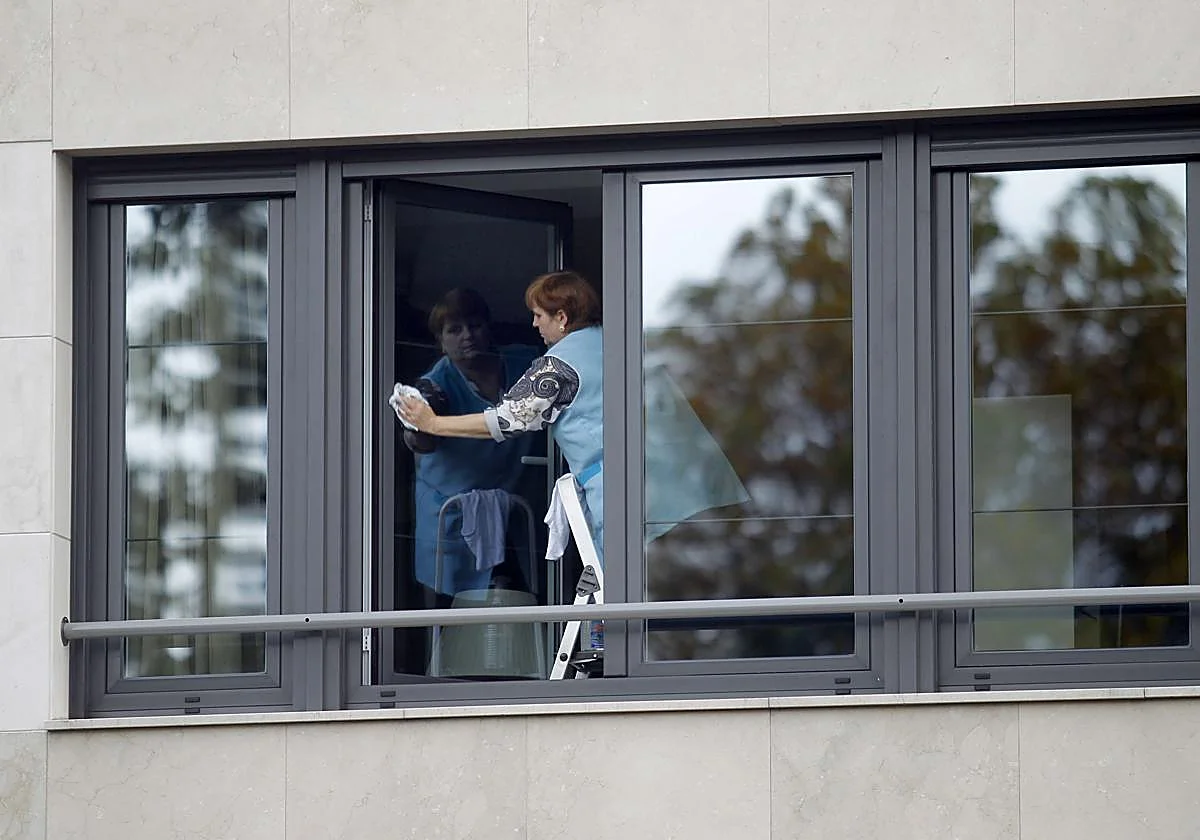
The countdown has come to an end. As of this Friday, around 350,000 Spanish families that employ domestic workers are obliged to have an occupational risk assessment, as required by the royal decree approved in September 2024. The measure, which seeks to equalize the conditions of this group with those of the rest of the workers of the General Regime, introduces a new requirement whose absence can result in fines ranging from 2,451 to 49,000 euros in aggravated cases.
This new obligation has generated concern among thousands of employers, especially among those households made up of elderly people or pensioners, who represent an important part of those who resort to this service. After a six-month adaptation period given by the Ministry of Labor, the regulation is now fully applicable and the Labor Inspectorate will be able to demand compliance as of today.
A royal decree to strengthen rights in a precarious sector
The regulatory change is part of the Government’s objective to improve the working conditions of domestic workers, a highly feminized and precarious group. The approval of the royal decree in 2024 was a significant step forward, taking steps towards equalization with other sectors -although there are still aspects to be developed-.
To facilitate the adaptation, the National Institute for Occupational Safety and Health (INSAH) launched in May the platform www.prevencion10.esa free portal designed so that any family can draw up its occupational risk prevention plan at no additional cost.
How to do the risk assessment: step by step
Employers must access the Prevención10 platform, enter their data and those of their employee, and complete an initial questionnaire that analyzes different aspects of the home and work:
-
Existence of stairs, slopes or dangerous areas.
-
Presence of pets.
-
Condition and electrical installation.
-
Type of tasks performed: cleaning, cooking, ironing, care of minors or elderly or dependent people.
At the end of the questionnaire, the tool provides an “Occupational Risk Prevention Plan”, which the employer must download, print and sign together with the worker. This document must be kept available in case the Labor Inspectorate requires it.
The platform also suggests concrete preventive measures if risks are detected: from reorganization of spaces to ergonomic recommendations or improvements in home safety.
In addition, employers have access to a toll-free helpline (91 363 43 00), operating Monday to Friday from 9:00 am to 2:00 pm.
Penalties: from 2,451 to nearly 49,000 euros
The Ministry of Labor has warned that failure to comply with this obligation is a major infraction. Fines can be:
-
From 2,451 to 9,830 euros in most cases.
-
Between 24,000 and 49,000 euros if there are aggravating circumstances.
The Government assures that the measure does not generate economic costs or bureaucratic burden, but for many families it is an extra requirement at a complex time for the sector.
A shrinking sector: 86,650 fewer female employees in a decade
While these obligations are being reinforced, domestic employment is clearly on a downward trend. Since 2015, the number of registered female workers has fallen by more than 20%, from more than 436,000 to less than 350,000 in 2025.
The causes, according to trade unions and experts:
-
Successive increases in contributions.
-
The sharp increase in the minimum wage, which has grown by more than 60% in six years.
-
The general increase in the cost of living.
All of this has meant that for many families having a domestic employee is financially unaffordable, in some cases encouraging irregular employment.
Pending development: medical examination and anti-harassment protocol
The unions point out that the new law still leaves some loose ends. It remains to be finalized:
-
The right of female workers to a free medical checkup every three years.
-
The creation of a protocol against violence and harassment in domestic work.
Both measures are still pending regulation.
An obligation that marks a before and after
Although the risk assessment may seem a minor formality, its mandatory nature represents a profound change in the sector. For the first time, employer households are subject to preventive regulations similar to those of any company, with equivalent inspections and sanctions.
The goal is clear: to improve the safety, dignity and protection of thousands of women who have historically worked with almost no rights.
From now on, compliance with these regulations is not only a legal obligation, but also a further step towards the professionalization of an essential sector that has been invisible for decades.