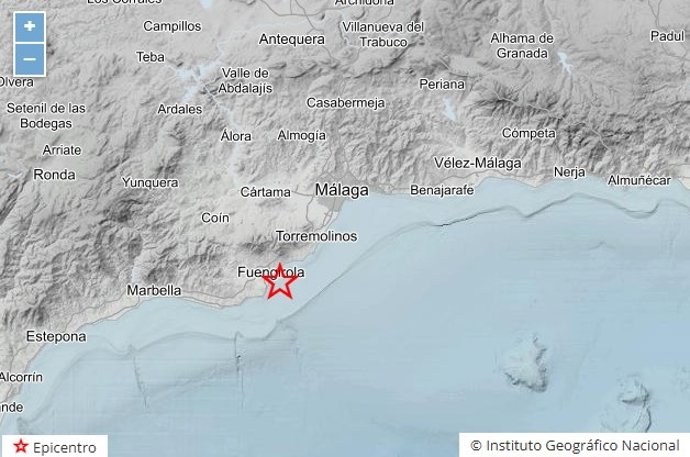
An earthquake in Malaga of magnitude 4.8 has been registered this Friday December 5 by the National Geographic Institute (IGN). The earthquake had its epicenter one kilometer from Fuengirola and occurred at a depth of several kilometers, which did not prevent it from being felt in different localities of the province.
The tremor, one of the most intense of the year in the area, was felt in municipalities such as Mijas, Benalmádena and Alhaurín el Grande, among others. For the moment, no personal or material damages have been reported, although the tremor generated concern in part of the population.
Generalized sensation in different parts of the province
According to the IGN, due to the intensity of the earthquake, it “could have been felt quite clearly in the municipalities of Mijas, Benalmádena and Alhaurín el Grande“, which suggests a wide area of perception of the earthquake. Although it is not ruled out that the tremor has also been felt in other localities of Malaga, the testimonies of citizens are still being collected.
#earthquake 05/12/2025 09:38:35UTC SE FUENGIROLA_MA mag=4.8 prof=77km revised calculation https://t.co/0u0ELFsSBu
– IGN Seismology (@IGN_Sismologia) December 5, 2025
As usual in these cases, the NGI has activated the so-called macroseismic questionnaire, a tool in which residents can report what they were doing at the time of the tremor, whether they were asleep or awake, what their reaction was and whether objects moved or fell.
The collection of this data, together with the technical information provided by the seismographs, allows the Institute to assess more accurately the real intensity of the earthquake and to estimate possible effects or damage.
A protocol dating back to the 18th century
The macroseismic questionnaire, which is still in use today, was implemented in Spain by order of King Ferdinand VI, shortly after the Lisbon earthquake of 1755, which caused nearly 100,000 deaths throughout the Peninsula. Since then, this instrument has evolved, but it is still considered by the NGI as “essential” for alerting the population and measuring the impact of seismic movements.
Five earthquakes in one month and the strongest in six months
Although recent seismic activity in the area had been scarce during the last week, the area around Malaga has registered five earthquakes of different intensities in the last month, according to information provided by the Institute itself.
Friday’s earthquake was the most significant: “This is the strongest earthquake in the last six months,” official data indicate, “surpassing the one that took place on October 18 of this year, which reached a magnitude of 3.2“.
Registered an earthquake of magnitude 4.8 with epicenter in #Fuengirola #Málaga
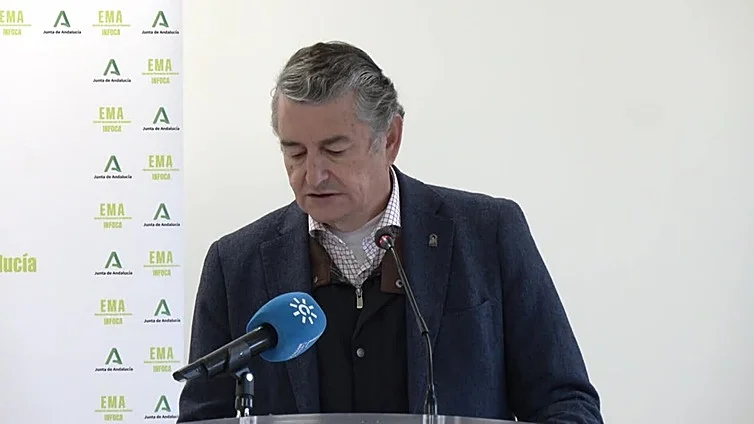
▶️El counselor of @InteriorJunta activates pre-emergency phase of the Plan Before the Seismic Risk.
▶️Registrados warnings from municipalities of Malaga, Seville and Cordoba.
▶️Sin damage.
Follow the #advice112👇 pic.twitter.com/C4JWMr6VR6– EMA 112 (@E112Andalucia) December 5, 2025
The frequency of these movements is a reminder that the province of Malaga, and in particular its coastal strip, is located in an area of moderate seismic activity, where tremors occur with some regularity, although they rarely have serious consequences.
The importance of citizen monitoring
The effectiveness of the earthquake detection and evaluation system in Spain depends largely on citizen collaboration. The authorities insist that the reports sent by those who have felt the tremor are fundamental to gauge the real intensity of the phenomenon on the surface.
The reports on the perception of the earthquake allow fine-tuning the intensity maps and improve the capacity to respond to future episodes. In this case, the IGN will continue to collect data during the next hours to determine with greater accuracy the territorial impact of the earthquake.
An episode without serious consequences, but which rekindles seismic alert
Although this new earthquake in Malaga has not caused any casualties or material damage according to preliminary reports, it has once again brought to the table the seismic fragility of certain areas in the south of the peninsula. The repetition of earthquakes, with epicenters relatively close to each other, raises the need to continue reinforcing prevention and education measures in the face of seismic movements.
Friday’s activity once again demonstrates that constant monitoring and public preparedness are key to reducing the impact of possible future earthquakes in the region. For the moment, Malaga remains calm, although under the watchful eye of experts.