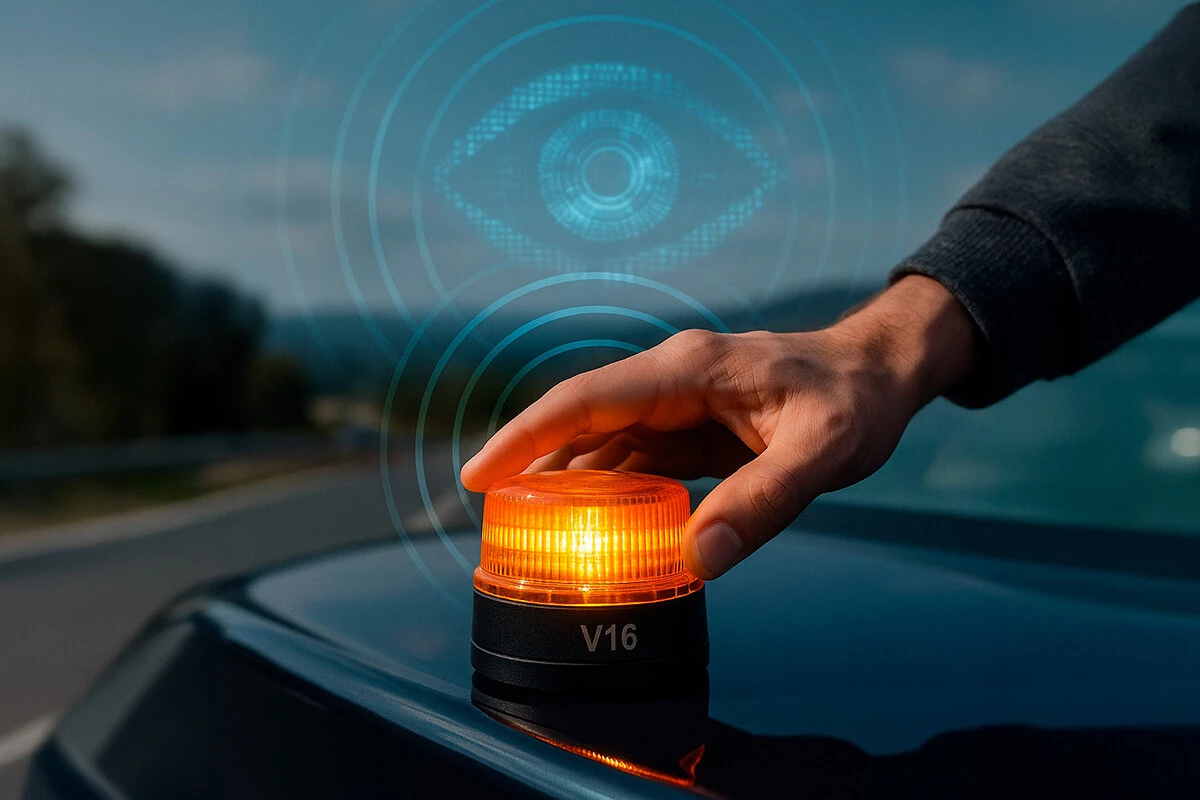
While drivers and manufacturers finish adapting to the definitive arrival of the V16 Beacons, the General Directorate of Traffic (DGT) has the next phase of its emergency road signaling strategy ready. As of January 1, 2026, the date on which the V16 light beacon will replace the traditional emergency triangles, the V27, a new digital signal defined by the DGT as a “virtual triangle”, will also be integrated.
Both systems will coexist, but their operation and their role in road safety will be very different. While the V16 is a physical device that the driver must place on the vehicle, the V27 cannot be touched or seen with the naked eye: it acts as an intelligent warning that will appear directly on the car’s instrumentation.
V16 Beacons, mandatory as of 2026
The V16 beacon has become one of the most talked-about road safety devices in recent years. Its definitive implementation will come on January 1, 2026, when it will be mandatory for all vehicles circulating in Spain, completely replacing the emergency triangles.
This luminous device must meet one key requirement: it must be connected and geolocated. Thanks to this, every time a driver activates a V16 beacon, the location of the damaged or accident vehicle will be automatically sent to the DGT 3.0 platform, the system that centralizes traffic and mobility information in real time.
However, since their announcement, the V16 Beacons have generated controversy. One of the most repeated criticisms is its limited visibility during the day, especially in situations of sharp curves or changes in gradient, where the light beam can go unnoticed and generate risky situations.
The V27, the so-called “virtual triangle”.
This is precisely where the V27 comes into play, a technology that does not replace the V16, but complements it. Unlike the physical beacon, the V27 is not an object that is placed on the road. This is a virtual signal that will be displayed directly on the vehicle’s on-board systems.
The V27 is regulated by Royal Decree 159/2021, of March 16, the same that establishes the legal framework for the V16. Although this regulation came into force in July 2021, the DGT will not start implementing this technology until January 2026.
From that date on, while V16 will be mandatory, V27 will be voluntary. Its operation will be based on the connectivity of the vehicle with the National Access Point for Traffic and Mobility Information, integrated in the DGT 3.0 platform.
How the V27 beacon works in practice
When a driver activates a V16 beacon or when a hazard is registered on the road (such as a stopped vehicle, an accident or an obstacle), the information will be sent to the DGT cloud. From there, the V27 will cause the warning to appear on connected vehicles driving in the area.
The warning will be displayed in the form of a virtual triangle on the car’s instrumentation, giving advance warning of the risk. In this way, the driver will receive the information even before visual contact with the incident, which is especially useful in low visibility or heavy traffic conditions.
The DGT has not yet specified how exactly the V27 will be integrated into all vehicles, but has made it clear that it will be part of the digital equipment and will depend on the car being connected to the national traffic system’s cloud.
Technology designed for the road of the future
The arrival of the V27 fits in with the technological evolution of the automotive sector. Vehicles are increasingly incorporating connected services, and communication between cars and traffic systems is emerging as a key tool for reducing accidents.
In this context, V16 Beacons are considered only the first step. Its mandatory nature ensures that any incident is recorded and reported, while the V27 will allow immediate and massive dissemination of this information to nearby drivers.
This system relies on V2V (vehicle-to-vehicle) communication technologies and cloud-based telematics services. The goal is for vehicles to be able to anticipate risks, not just react when they are already on top of the problem.
Less controversy and more prevention
Unlike V16, V27 should not generate as much controversy. As it does not depend on the visibility of a physical light, its effectiveness is not affected by sunlight, rain or road terrain. In addition, as it is a signal that appears directly on the vehicle, the driver’s reaction margin increases considerably.
The DGT considers that this technology will be key to reducing secondary accidents, one of the main risks when a vehicle stops on the road or shoulder.
V16 and V27: complementary systems
Far from competing with each other, the V16 and V27 are designed to work together. The physical beacon will continue to be essential to signal the presence of the stopped vehicle and send its location, while the V27 will amplify that warning, bringing it directly to the interior of nearby cars.
Thus, the system combines physical and digital signage, an approach that aims at a new way of understanding road safety, more preventive and less reactive.
A progressive change in mobility
Although the implementation of the V27 will be gradual and will depend on the level of connectivity of the vehicles, its arrival marks a before and after in traffic management in Spain. The road ceases to be a space where each driver faces unforeseen events alone and becomes an interconnected environment, where information circulates as fast as the vehicles themselves.
With the V16 Beacons about to become mandatory and the V27 waiting its turn as digital reinforcement, the DGT is moving towards a mobility model in which technology not only accompanies the driver, but anticipates danger and gains time, the most decisive factor when it comes to saving lives.