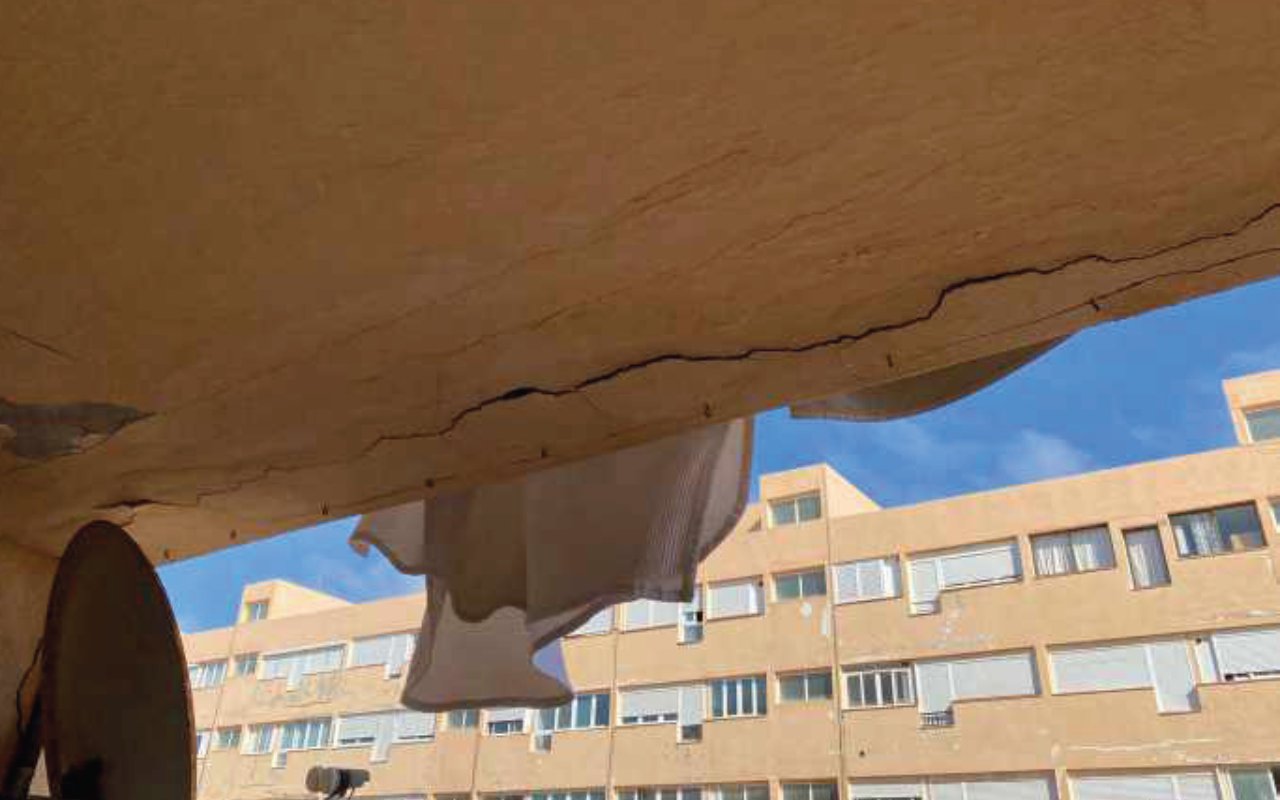
The Don Pepe case now enters a decisive stage after the legal report commissioned by the City Council of Sant Josep and which has concluded with the presumption of legality of block A. The opinion itself warns that, even equating block A to B, both buildings have works and changes of use that did not appear in the 1964 projects. This scenario leads directly to the out-of-planning regime provided for in the Balearic Urban Planning Law (LUIB), although with a key question still open: what type of out-of-planning applies and what real margin of intervention it leaves.
The “last drawback” pointed out by the report
After defending the legal equivalence between block A and block B, the report identifies what it calls the last drawback: the existence of actions not covered by a license.
Among them, he lists several of urban planning relevance:
- The construction of an additional floor: both buildings currently have five floors.
- The change of use in Block B: the ground floor planned and licensed as a “commercial complex” ended up being transformed into four dwellings.
- Other subsequent actions, such as the closing of balconies, executed without a license.
With this starting point, the report concludes that the two buildings would be in the same situation of out of order.
-
Don Pepe: the independent report states that it is “technically and constructively rehabitable”.
-
The next step to reverse the Don Pepe’s declaration of ruin
Article 129 of the LUIB
The core of the debate is no longer whether or not there is a license, but which section of Article 129 of the LUIB is applicable. The report places the discussion between three possible frameworks:
- Article 129.2 b), the most restrictive regime.
- Article 129.2 c), which is broader if the building was originally legal and the irregularity is subsequent.
- Or even Article 129.3, in view of the existence of horizontal property.
In addition to this, there is a current regulatory element: Law 7/2024 recently reformed the wording of paragraphs b) and c), which directly affects the scope of the permitted works.
If 129.2(b) applies: the hardest scenario
If Don Pepe were to fall under Article 129.2 b), the margin for action would be minimal. The report itself recalls that, under this regime, only works strictly necessary for reasons of public health, safety or hygiene of residents or users are allowed.
Translated to the specific case: if this were the definitive qualification, there would be no room for rehabilitation in a broad sense, but only very limited interventions.
If 129.2(c) applies: a rehabilitation framework with limits
The scenario changes significantly if Article 129.2 c) is chosen. This section is based on a different premise: buildings that are legally established in which, at a later date, extensions, alterations or changes of use were made without a license.
Under this regime, the LUIB allows works of health, safety, hygiene, repair, consolidation and reform, as well as those necessary to comply with fire regulations, accessibility and the Technical Building Code, provided they do not affect the illegally executed part.
Applied to Don Pepe, the report argues that if block A is legally equated to block B by presumption of legality, the catalog of possible works would be substantially expanded, although with the clear limit of not intervening on the elements not covered by the license.
Article 129.3: the “surgical” route in condominiums
The report also introduces a third possibility of high practical impact. In the case of buildings constituted under the horizontal property regime, Article 129.3 of the LUIB allows the restrictions derived from the out-of-order status to affect only the specific units that do not comply with the regulations, without automatically extending to the entire building.
In other words, the irregularity could be isolated, provided that it is technically accredited which parts comply with the law and which do not.
An essential first step: a new technical study
The determination of the applicable regime does not correspond to this legal report, but to a detailed technical construction study and a precise comparison with the projects included in the 1964 file.
Only on the basis of this analysis will it be possible to decide whether Don Pepe falls under paragraph b), c) or under the specific regime of horizontal property.
All of this will make it possible to know whether simple safety repairs can be implemented, whether the door is open to more extensive rehabilitation, or whether the solution can be modularized for individual dwellings or units.