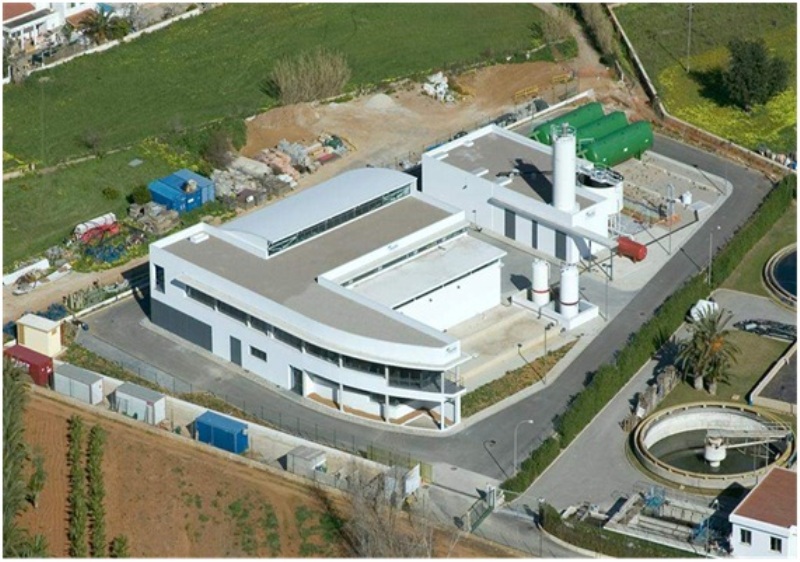
Ibiza has at least two critical years ahead of it before it stops living on the edge in terms of drinking water supply. That is the deadline set by the expansion of the Santa Eulària desalination plant, whose tender has just been approved by the Balearic Government through Abaqua, and which will significantly increase the production capacity of desalinated water on the island.
Until this work is completed, the system will continue to operate with no real safety margin. As happened this summer, a major breakdown in any of the desalination plants during the high season would jeopardize the supply, since production is working at maximum capacity and the only available buffer is that offered by the reservoirs. There is water in storage for a few hours. Maybe a few days.
The expansion that will allow the system to breathe
The project will allow the Santa Eulària desalination plant to increase from 16,000 to 22,000 cubic meters per day, almost 40% more, through the incorporation of a fourth reverse osmosis rack.
This is not a local improvement: the island’s three desalination plants are interconnected, so the new flow can be redistributed according to the needs of the system as a whole.
This point is key because the Ibiza desalination plant cannot be expanded, which makes Santa Eulària the only structural pillar capable of absorbing the growth in demand, until the fourth desalination plant is available for which it will be many years, perhaps a decade.
The Sant Antoni plant, on the other hand, will be reinforced with a mobile desalination plant, a backup solution designed for emergencies and consumption peaks, but insufficient to solve the basic problem. It will provide an additional 1,000 cubic meters per day.
Skyrocketing production and depleted aquifers
The project comes after years of sustained increase in the consumption of desalinated water, caused by the accelerated deterioration of aquifers, both in quantity and quality. According to Abaqua data, Ibiza has gone from consuming about 5 cubic hectometers per year in 2009 to almost 13 in 2024, and everything indicates that in 2025 it will exceed 14 cubic hectometers.
This evolution has led to an increasing number of months of operation at the limit of their capacity, reducing to a minimum the capacity to react to breakdowns, drought episodes or peaks in demand associated with the tourist season.
The fourth desalination plant, just a promise
Meanwhile, the fourth desalination fourth desalination plant in Ibiza remains on paper. It has no defined location, no technical project, and no timetable. To date, it is no more than a political commitment, with no real impact on the island’s production capacity.
For this reason, the Santa Eulària extension has become the centerpiece to prevent the system from collapsing in the coming years.
A complex project, almost 10 million and no margin for error
The project includes the remodeling of the seawater intake, new pipelines, filters and high-pressure equipment, a new reverse osmosis train, improvements in the pumping and distribution of treated water, as well as the adaptation of the electrical and control installations and the brine discharge system.
Everything has been designed with criteria of minimum environmental impact and, above all, with a priority objective: to keep the plant operational during the works, aware that Ibiza cannot afford prolonged stoppages.
The base bidding budget amounts to 9.99 million euros, including VAT. In addition, there is a technical assistance contract for construction management and health and safety coordination for 314,600 euros, with a total term of 25 months. The execution period of the works will be 23 months, once awarded and authorized by the Consell de Govern.
Two more summers on the edge
Until the expansion becomes a reality, Ibiza will continue to rely on a system stressed to the maximum, where any relevant failure in a desalination plant during peak demand months could have immediate consequences.
The expansion of Santa Eulària, together with the mobile desalination plant of Sant Antoni and a greater incorporation of desalinated water by the municipalities, will alleviate the pressure on the aquifers and improve the capacity to respond to emergencies.
But the message is clear: for the next 24 months, Ibiza will continue to pray that nothing goes wrong. Only then, if all goes according to plan, can the island begin to leave behind a water management based on the permanent limit.
Unless the rains recharge the aquifers, as the torrential rains of the last two weeks have done.