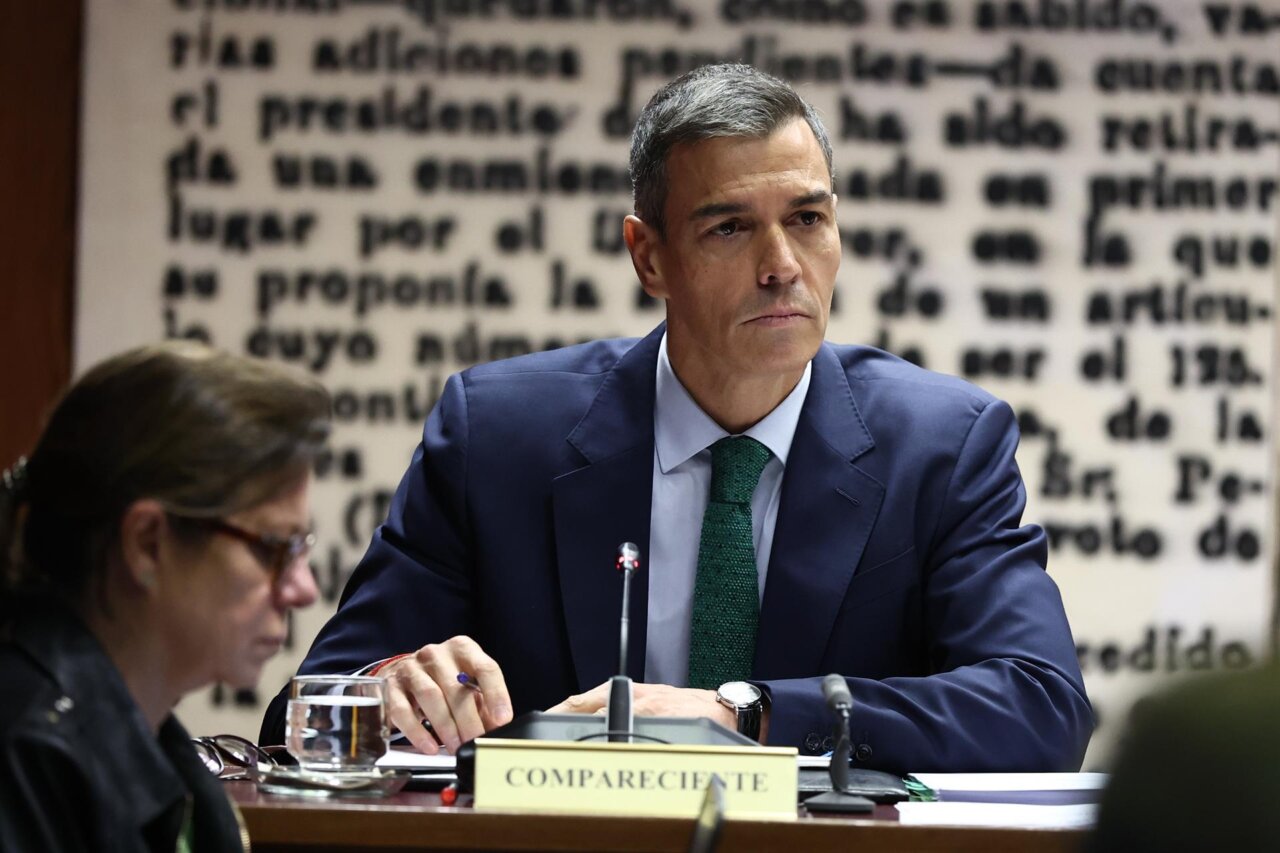
The City Council of Palma has once again placed the President of the Government, Pedro Sánchez, at the center of the controversy after approving this Thursday a motion declaring him persona non grata and demanding both his resignation and the calling of general elections. The initiative, promoted by Vox and supported by the PP, has reopened the political and legal debate on the scope and meaning of such municipal declarations, which have no legal effect but have a significant symbolic charge.
A motion loaded with harsh accusations
The motion approved by the Plenary of the City Council of Palma was not limited to declaring Pedro Sanchez persona non grata, but also described the President of the Government as a “despicable character”. The qualification is part of the text supported by Vox and the PP, which includes strong criticism of the management of the chief executive.
During the defense of the motion, the spokesman for Vox, Fulgencio Coll, did not skimp on terms. For Coll, Sanchez is “
The PP supports and asks to turn the page
The Popular Party ‘s support for the motion was not merely formal. Councilman Llorenç Bauzá defended the measure stating that “corruption cannot be normalized” and that Spanish society needs to “turn the page” of what he considered a “succession of scandals” that affect not only Pedro Sánchez, but also his government and his party.
The request for new general elections arises, according to Bauzá, from the need to offer citizens an alternative after a legislature marked by these tensions and accusations.
Reactions and abstentions at the Plenary Session
The motion was not a unanimous statement. While Vox and the PP supported the initiative, other political groups showed their rejection or abstained during the vote.
Podemos abstained in the vote and, although it tried to get the Plenary to include an amendment to publicly condemn “the genocide” of the Palestinian people attributed to the State of Israel and its president, Benjamin Netanyahu, its proposal was not accepted.
For their part, Més per Palma and the PSOE voted against the motion. The sovereignist spokeswoman, Neus Truyol, considered that Vox’s proposal sought only to “bring out the drums of tension” instead of addressing fundamental municipal problems.
The socialist spokesman, Francisco Ducrós, described the motion as “unworthy” and “illegal”, and regretted that the PP had “assumed” the discourse of the “far right”. Ducrós also recalled the corruption cases that have affected the Balearic PP in previous legislatures and added that even the party president, Alberto Núñez Feijóo, “went on vacation in the boat of a drug trafficker”, in a critical reference to ethical issues and conduct in Spanish politics.
A precedent with Rajoy and a recent one with Sánchez
The Palma motion is not an isolated event. The approved text explicitly mentions precedents in other Spanish cities. One of them occurred in 2016 in the City Council of Pontevedra, where the then former president Mariano Rajoy was declared persona non grata, in protest against the installation of a paper mill next to the estuary.
More recently, the Albacete City Council adopted a similar measure against Pedro Sánchez last month with the support of Vox and the PP. These precedents highlight that these types of declarations are rather symbolic and respond to specific political contexts in each municipality.
The debate on the legality of the figure
The declaration of persona non grata has no direct legal effect, which has generated doubts and discussions about its usefulness and scope. It is a purely symbolic figure, which does not imply legal prohibitions, nor can it prevent official visits or practically limit the activity of a President of the Government.
Despite their lack of legal force, these declarations function as a political instrument of protest and expression of rejection, especially when opposition groups seek to make visible their dissatisfaction with national decisions or policies at the local level.
The case of Palma has revived this debate, as there are those who consider that the figure only serves to “bring out the drums of tension”, as Neus Truyol stated, while others see it as a legitimate way to express the feelings of a part of the electorate against what they consider a bad management.