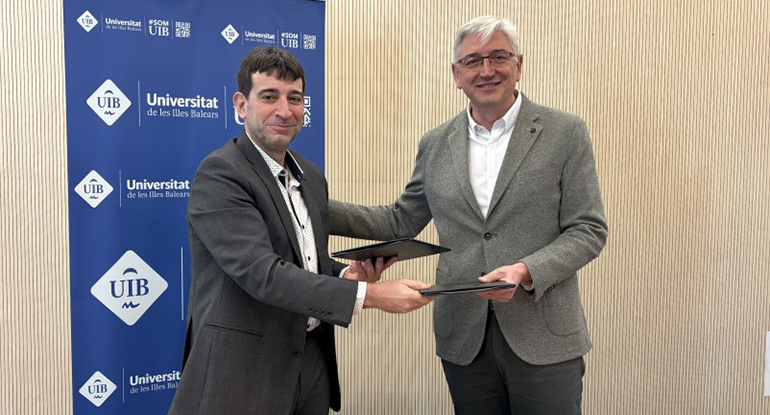
The University of the Balearic Islands (UIB) and the company Veolia have formalized a collaboration agreement to launch a pioneering project in Mallorca focused on efficient water management linked to tourism. The initiative, called WATOURISM, will be deployed in the municipality of Calvià as a pilot experience and aims to become a benchmark that can be replicated in other tourist destinations with high pressure on water resources.
The project, which is co-financed by the Ministry of Science, Innovation and Universities and European ERDF funds, has a budget of 764,000 euros and has an execution horizon until September 2027. In addition to the UIB and Veolia, entities such as Cetaqua, the University of Valladolid, the University of Girona and the GLOWATER research group of the Balearic University are participating.
Calvià, laboratory of water innovation
Calvià, one of the main tourist resorts in Mallorca, will serve as a real laboratory to test new tools for smart water management. The choice of the municipality responds both to its significant tourist demand and to the challenges posed by the sustainability of water resources in a context of climate change and marked seasonality.
The approach of the WATOURISM project is based on three main lines of work that seek to integrate science, technology and territorial planning to improve water management in the tourism environment.
One of these lines focuses on the use of data from smart meters and artificial intelligence systems to improve territorial management and detect anomalous water consumption. This strategy will enable managers to better understand consumption patterns and act more efficiently, reducing losses and optimizing the use of the resource.
Measurement and management of the water footprint
Another fundamental axis of the project is the measurement and management of the water footprint of tourism through the Act4water standard. This methodology seeks not only to quantify the water consumed directly and indirectly by tourism activities, but also to promote compensation and resilience projects that reduce pressure on local resources.
The implementation of standards such as Act4water will allow those responsible for the initiative to draw comparable and consistent indicators that can serve as a reference beyond Calvià, facilitating the transfer of knowledge to other areas with similar problems.
Advanced models for water policies
The third major line of action is the development of advanced models to evaluate and design water demand policies in both hotels and residential areas. These models will be key to anticipating water stress situations and proposing measures to balance the needs of residents and visitors without compromising the availability of the resource.
The UIB stresses that WATOURISM will allow the transfer of scientific knowledge to public and private decision making in a context marked by water scarcity and the impact of climate change. The project aims to demonstrate that tourism can evolve towards a more efficient model in the use of resources, compatible with economic competitiveness and the welfare of residents and visitors.
Public-private cooperation as a strategic key
For its part, Veolia stresses the strategic value of public-private collaboration to respond to one of the main structural challenges of the Balearic Islands. The combination of local academic knowledge, the company’s operational experience and the technological support of its Cetaqua innovation center will allow, according to the company, to offer concrete and applicable solutions in the short and medium term.
This type of cooperation is especially relevant in a scenario in which the pressure on water resources in tourist areas requires solutions that integrate multiple perspectives (scientific, technical, business and social) to generate real impacts.
A broader cooperation framework
The agreement signed between the UIB and Veolia will have an initial duration of three years and is not only limited to the development of the WATOURISM project. It also envisages the creation of a stable framework for cooperation in areas such as innovation, digitization and advanced data management. This roadmap will make it possible to consolidate an ongoing working relationship that can meet future challenges arising from natural resource management and sustainability.
The ultimate goal of this collaboration is to lay the foundations for a more water resilient tourism model, capable of adapting to an increasingly demanding climate scenario and preserving a key resource for the economic and social future of Mallorca.