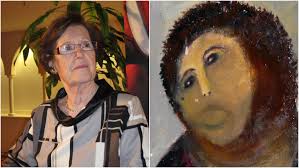
Cecilia Giménez Zueco, the neighbor of Borja who went down in history for the unique restoration of the Ecce Homo of the Sanctuary of Mercy, died on Monday at the age of 94. The news was confirmed by the sanctuary itself through a statement on social networks, in which they fondly remembered a woman deeply linked to the cultural and social life of the municipality of Zaragoza.
His name rose to fame in 2012, when he decided to intervene in a 20th century mural painting signed by Elías García Martínez that showed a remarkable deterioration. What began as a well-intentioned gesture ended up becoming a worldwide phenomenon: the result of the restoration was so far from the original image that the work became a viral icon, replicated in media around the world and commented endlessly on social networks.
From polemic to cultural phenomenon
Cecilia’s intervention, carried out without prior authorization, initially provoked a wave of criticism and ridicule. However, with the passage of time, the perception changed and, far from being relegated to public scorn, the restorer came to be seen as an endearing symbol, arousing sympathy both inside and outside Spain. Journalistic investigations, documentaries and reports revisited her story, providing context and nuances to an episode that was already part of popular culture.
The impact was immediate in Borja: since that summer, the Sanctuary of Mercy began to receive a constant influx of visitors who wanted to see in person the famous Ecce Homo, popularly renamed “Ecce Mono”. Tourism multiplied and the town experienced a before and after thanks to an unexpected event.
A beloved and committed neighbor
Beyond her fame, those who knew Cecilia remember her as a discreet woman, self-taught and passionate about painting from a very young age. Throughout her life she produced numerous works, always from a humble and personal artistic vocation. In her last years she lived in the Borja nursing home with her son, who suffers from cerebral palsy.
Over time, even the local authorities recognized her figure: the then mayor of Borja, Eduardo Arilla, recalled how the town ended up wrapping her up when thousands of people came to the Romería de San Bartolomé and gave her a public ovation, marking a turning point in the way her gesture was understood.
An unexpected legacy for Borja
The economic impact of the phenomenon was also notable, since thanks to the increase in visitors, the sanctuary and the Sancti Spiritus Hospital Foundation received significant income that allowed them to improve facilities and expand care for people with fewer resources. A collective benefit that no one had foreseen when Cecilia took up the paintbrush.
Her solidarity was also evident in other gestures, such as the donation of one of her paintings, Las bodegas de Borja, for a charity auction whose funds were donated to Caritas. An act that reinforced the image of a generous woman, uncontroversial, who never sought the limelight.