
This is not a news item to understand Venezuela. It is a story of power, military technology and a surgical operation told as if it were a movie, but which -according to the official version of the United States- really happened. And it happened in the wee hours of the morning, when almost the whole country was asleep.
A lightning operation while Venezuela was sleeping
The attack began a few minutes after 1 a.m. local time on Saturday. At that time, U.S. Army commandos from the feared Delta Force launched a special operation to capture Venezuelan President Nicolas Maduro and his wife, Cilia Flores, both accused by Washington of narco-terrorism.
According to the official U.S. account, the couple was captured while sleeping and taken out of the country. The exact location of the arrest has not been publicly disclosed, a detail that remains unconfirmed independently.
The mission had a name of its own: Operation Absolute Resolution.
Four days prepared after months of rehearsals
Although the execution was swift, the operation had been planned for at least four days and was, according to the U.S. General Staff, the culmination of months of preparation, drills and intelligence work.
«It was discreet, precise and conducted during the darkest hours of January 2,» Dan Caine, chairman of the U.S. Joint Chiefs of Staff, explained at a press conference. The military commanders waited for the exact moment: the so-called «wolf moon,» a supermoon that offers greater nighttime visibility without the need for artificial illumination.
Trump saw it all live
President Donald Trump followed the operation in real time from a room in his Mar-a-Lago (Florida) mansion, surrounded by military and intelligence personnel.
«I literally watched it like it was a TV show,» he said later in an interview on Fox News. Trump recounted the operation with relish: impossible break-ins, steel doors forced in seconds, and a «violent and amazing» action that, he said, «no one else could have done.»
Delta Force, helicopters and a taken sky
The mission involved elite Delta Force units, supported by a dozen helicopters from the 160th Special Operations Aviation Regiment, known as the Night Stalkers.
The helicopters took off shortly before midnight, flying at very low altitude – about 30 meters above the water – to avoid detection. As they approached the Venezuelan coast, the US deployed a full military air corridor:
-
F-22, F-35 and F-18 fighters
-
B-1 Bombers
-
Support aircraft and numerous drones
-
Joint Navy, Marines and Air Force coverage
In total, more than 150 aircraft participated directly or indirectly in the operation, according to military sources.
Total blackout in Caracas
During the early hours of the morning, the electricity supply in Caracas was deliberately cut off to leave the city completely dark and facilitate the intervention. Upon arrival in the area, U.S. helicopters were attacked and responded «with overwhelming force«, according to Washington’s version.
The official balance recognizes several Venezuelan citizens killed and wounded during the attacks, in addition to two wounded U.S. military personnel and a damaged helicopter, which could be recovered.
From helicopter to aircraft carrier
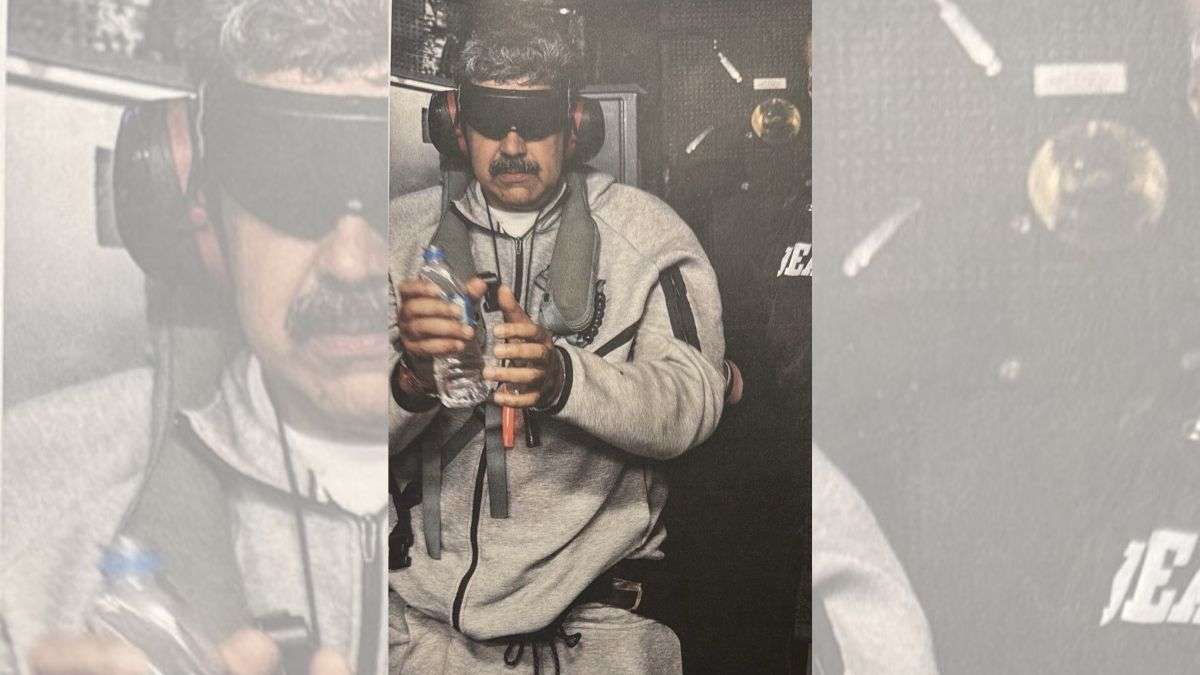
Once captured, Maduro and his wife were transferred by helicopter to the aircraft carrier USS Iwo Jima. From there, according to the United States, they were sent to New York, where they would be tried.
More than 14,000 U.S. troops remained deployed in the area, along with several aircraft carriers, including the USS Gerald Ford, the most advanced and lethal of the U.S. naval fleet.
A president obsessed with security
According to information published by The New York Times, Maduro sensed that an operation against him was imminent. He lived obsessed with security, surrounded by Cuban bodyguards, constantly changed his location, did not sleep two nights in a row in the same place and frequently discarded phones to avoid being traced.
Even so, according to Washington, U.S. intelligence was able to locate him thanks to a CIA agent infiltrated into the Venezuelan power circles.
A country in shock and a political future in the air
While the United States exhibits the operation as a surgical strike against the Chavista power, Venezuela has been plunged into an unprecedented political vacuum. The Government decreed a state of emergency, activated the Defense Plan in Miraflores and called on the population to «defend the homeland», but has not clarified who is now exercising effective power nor what is the real situation of the chain of command.
With the president out of the country -according to Washington- and without a clear succession, Venezuela’s immediate future moves between institutional uncertainty, the risk of internal instability and international pressure. The United States insists that there is an «opportunity for transition», while allies of Chavism denounce an illegal intervention. The political outcome of the country, today, is completely open.
Trump avoided setting deadlines on the US presence in Venezuela and made it clear that Washington does not contemplate an immediate withdrawal. «There are a lot of bad people in the country», he affirmed, assuring that the US will remain as long as it deems necessary to prevent «those people» from taking control of power. The US president also revealed that Venezuelan Vice President Delcy Rodríguez, whom he underlined as a leader «appointed» by Maduro, has been in direct contact with Secretary of State Marco Rubio and has shown willingness to collaborate with the White House. «We will do whatever it takes,» Trump said Rodriguez conveyed to him. «You have no other choice,» he finished off.
Trump has ruled out opposition leader and Nobel Peace Prize winner, María Corina Machado, as an alternative because she does not have «the necessary support and respect» to promote a political transition in Venezuela. For her part, Machado had previously posted on her social networks: «We are ready to take power».