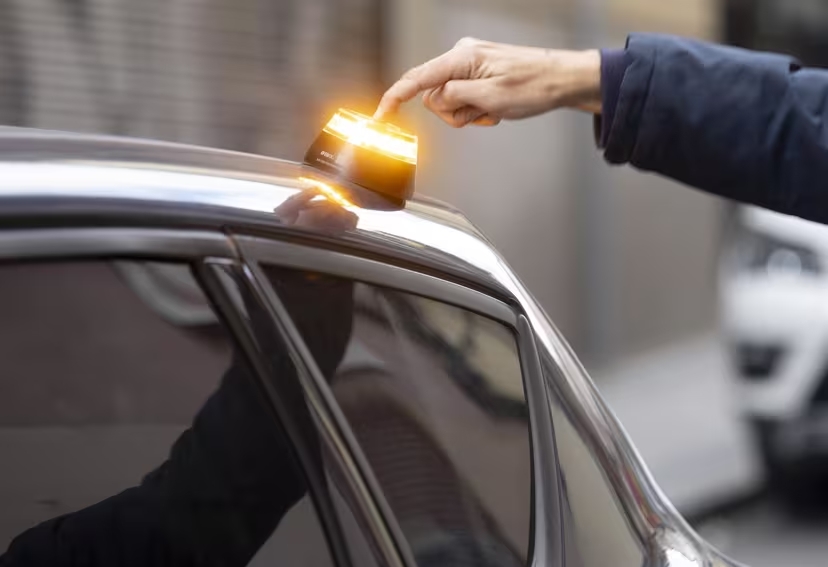
As of January 1, 2026, the V-16 beacon is already a mandatory element in vehicles circulating on Spanish roads. The measure that came into force means a definitive change in the way of signaling breakdowns and accidents, since it officially replaces the traditional pre-signaling triangles. With its implementation, the Directorate General of Traffic (DGT) seeks to reduce the accident rate and avoid risky situations on the shoulders.
Although the regulation had been announced for years, the arrival of the new year has marked the point of no return. From now on, not carrying the V-16 beacon in the vehicle or carrying one that is not homologated can result in a fine of 80 euros, a sanction considered minor and equivalent to that applied until now for not having the triangles.
What the regulations require as of January 1
The legislation establishes that V-16 beacons must be approved and certified by one of the authorized technical laboratories: IDIADA or LCOE. These entities are in charge of verifying that the devices comply with all the technical requirements for their correct operation and use on the road.
The mandatory V-16 beacon must be luminous and connected, which means that, in addition to emitting a visible signal, it transmits the exact location of the damaged or accident vehicle to the DGT 3.0 platform. This information reaches other drivers in real time via navigators, mobility applications and variable message boards.
Failure to comply with these requirements, either by not carrying the beacon or by using an unapproved model, carries the aforementioned penalty of 80 euros, applicable as of yesterday.
Withdrawal of homologations and doubts among drivers
The entry into force of the mandatory requirement has taken place in a context of some confusion. A few days before the regulation was to be applied, the DGT withdrew the homologation of several V-16 beacons that until then could be marketed.
As explained by Tráfico, this withdrawal was not due to technical failures or security problems, but mainly to the lack of renewal of licenses by the manufacturers. An administrative situation that generated concern among users who had already purchased these devices.
In view of this circumstance, the consumer association Facua has come out to reassure drivers, assuring that “the beacons purchased before losing their validity comply with all the technical safety specifications necessary to replace the traditional signaling triangles”.
DGT insists: “There is no vocation to fine”.
The Traffic Department has tried to reduce the tension in the first days of application of the rule. The deputy director of the DGT, Ana Blanco, has reiterated that “there is no vocation to fine” with this measure and that the main objective is to improve road safety.
In an interview with Cadena Ser, Blanco defended the implementation of the new system, explaining that “We replaced the triangles with this device that provides safety. This luminous and connected V-16 will improve our safety”.
In addition, he reminded that there is still room for drivers who have not done so to equip themselves with this mandatory element, stressing that “we have days to equip ourselves with this safety device”, despite the fact that the requirement has been in force since yesterday.
Which vehicles must carry the V-16 beacon
The obligation affects most of the vehicle fleet. Passenger cars, vans, buses, mixed vehicles, trucks and non-special vehicle combinations must carry the V-16 beacon, as stipulated in Annex XII of the General Vehicle Regulations.
In the case of motorcycles, the regulations do not make their use mandatory, although the DGT recommends their use for safety reasons.
The device should be stored loaded and in an accessible place inside the vehicle, such as the glove compartment. In the event of a breakdown or accident, the driver should turn on the beacon and place it from inside the car on the highest possible position, usually the roof, to maximize its visibility. In large vehicles, such as buses or trucks, it can be placed on the driver’s door.
How connected signage works
Once activated, the beacon emits a visible light signal and automatically sends the location of the stopped vehicle to the DGT 3.0 platform. This information allows other road users to be alerted in advance, even before they have visual contact with the broken-down vehicle.
After placing the beacon, it is up to the driver to assess whether he can safely leave the vehicle or whether he should remain inside it, thus reducing the risk of being run over on the road.
Privacy and geolocation: what data is being sent
One of the main concerns of drivers has been privacy. On this point, Borja Martín Palomino, Product Manager at Wottoline, explained to Europa Press that “the connected beacon does not monitor the driver: it only sends an anonymous signal when you turn it on in an emergency”.
The company, which has approved models such as FaseLight and iWottoLight, insists on the importance of differentiating “between simple emergency lights and approved and geolocated V-16 beacons”, in a market where devices that do not meet all the requirements coexist.
Palomino explained that the SIM integrated in these beacons is anonymous and is not associated with the driver’s name, ID or telephone number. “There is no need to provide any personal data to use the beacon. Only the position of the stopped vehicle and technical data of the device are sent to DGT 3.0, nothing else.” In addition, geolocation is only activated when the beacon is turned on due to an incident; while it is turned off, it does not emit any signal.
One of the great novelties of Traffic in 2026
The compulsory use of the V-16 beacon is one of the main new traffic and road safety features coming into force in 2026. It comes after a 2025 marked by numerous regulatory changes, such as the update of the General Traffic Regulations with about 90 new signs, more than 20 modified and several eliminated.
Also in July last year, the reform of the Vehicle Regulations was published, aimed at modernizing and decarbonizing freight transport. In this context, the V-16 beacon is consolidating its position as a key element of the new road safety model, which has been in full force since the beginning of this year.