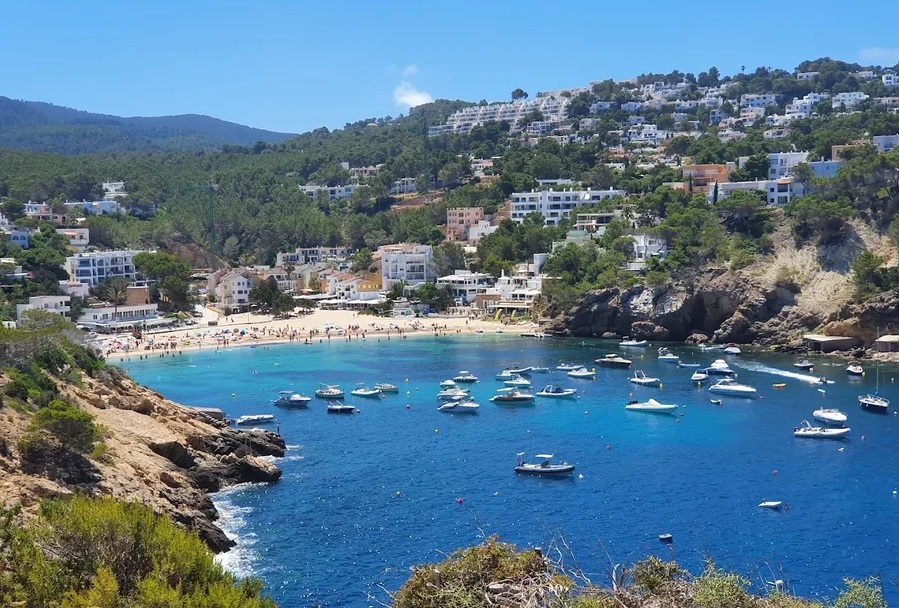
GEN-GOB has presented allegations to the Provisional Planning Rules (NPP) of Sant Josep de sa Talaia and has requested, for reasons of public interest, the total and indefinite suspension of the planning regarding new residential and tourist uses, considering that the municipality does not have sufficient water resources or infrastructure to assume the planned growth. The environmental organization bases its petition on the protection of the environment and the right to a healthy environment, as stated in Article 45 of the Constitution and recognized by the UN as a universal human right.
The group recalls that Sant Josep de sa Talaia has been subjected to strong urban and tourist pressure for decades, a dynamic that, in their opinion, contravenes the constitutional mandate to avoid land speculation. According to GEN-GOB, uncontrolled growth has generated environmental, social and economic problems, such as the depletion of aquifers, the existence of thousands of empty homes and the difficulty of access to decent housing for the resident population.
Criticisms of the Provisional Planning Rules
In its allegations, the organization argues that the NPPs initially approved by the Consell Insular do not reverse the existing situation, but rather deepen it, by allowing a municipality with serious water problems to double its population. GEN-GOB warns that rural land remains outside the suspension, despite intense urban pressure that undermines its agricultural and environmental function.
The environmental document recognizes, according to the collective, the structural limitation of water resources and the pressure on aquifers, and is theoretically aligned with the principle of not increasing water demand. However, GEN-GOB denounces that future demand is not quantified, detailed water balances are not presented, nor is it made explicit how supply will be guaranteed in episodes of drought or tourist population peaks.
Insufficient purification and lack of planning
Another critical point is the lack of wastewater treatment infrastructure. Despite the fact that the planning foresees a population increase of up to 50%, GEN-GOB stresses that there is no analysis of the real capacity of the WWTPs, nor their operation in seasonal peaks, nor are investments or execution schedules for their expansion or improvement specified.
The reuse of treated water, demanded by GEN-GOB since 2004, is mentioned as an objective, but without defined networks or implementation commitments, which leads the entity to conclude that current infrastructures cannot even meet present needs, let alone new urban developments.
An “argumentative” containment of growth
The environmental group considers that the claim of no population increase is a fallacy, since the planning would allow for a significant real increase. This circumstance, they add, disassociates growth from the real capacity of basic infrastructures such as water, sanitation or public facilities, invalidating any favorable environmental assessment based on obsolete urban planning regulations.
Rustic land, the great forgotten of planning
The NPPs do not modify the buildability of rural land, a decision that GEN-GOB considers erroneous, as it maintains and consolidates the diffuse urban pressure, especially associated with single-family homes, swimming pools, gardens, wells and septic tanks, one of the main sources of uncontrolled water consumption in the municipality.
Zero growth and tourism decline
Given this scenario, GEN-GOB argues that the suspension of planning should be total and permanent for residential and tourist uses, at least until the aquifers are recovered and the proper management of natural areas is guaranteed. The entity is committed to zero urban growth and considers it essential to apply measures to reduce tourism growth, as this sector exceeds the carrying capacity of the territory.