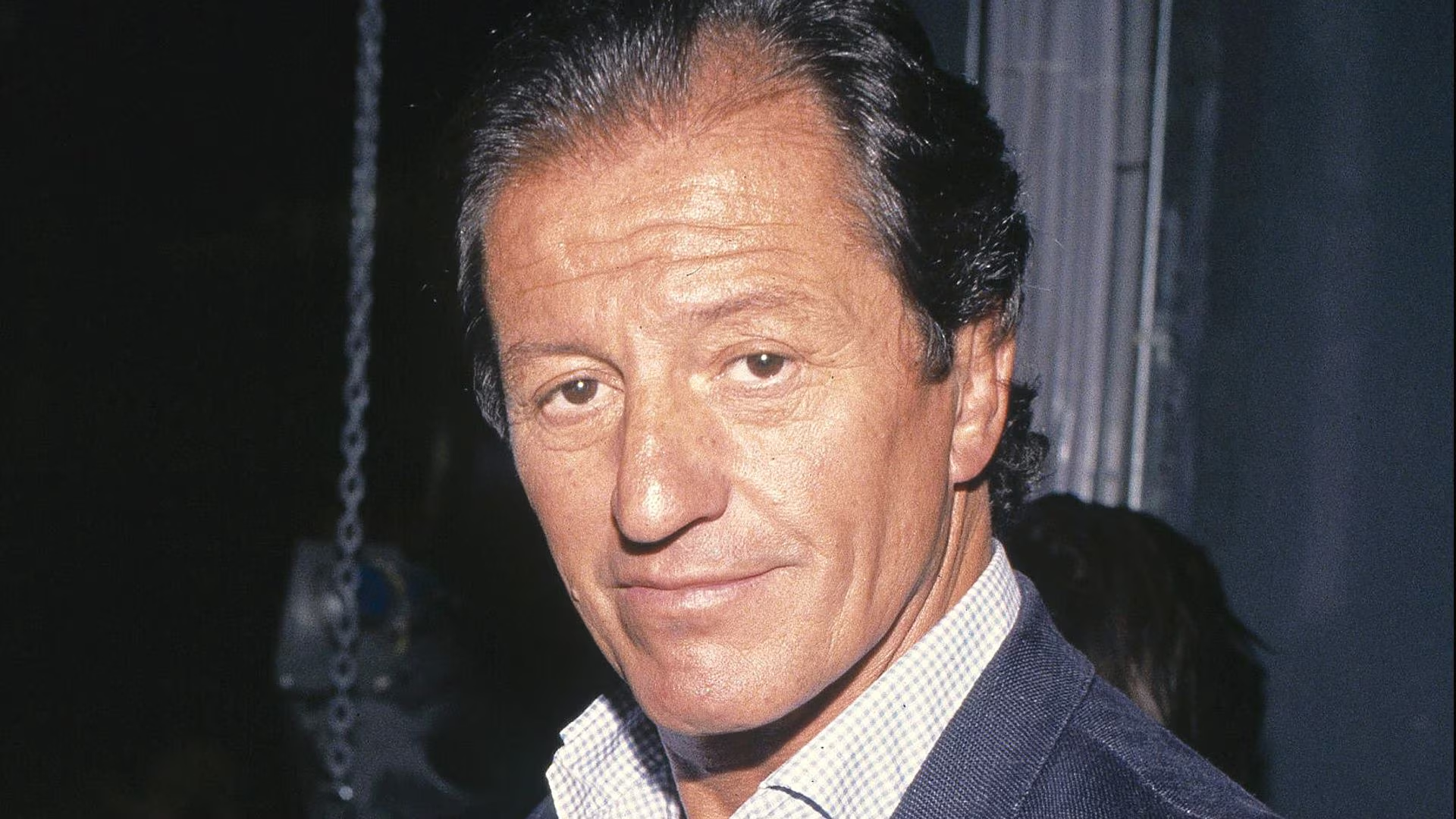
The world bids farewell to one of its most emblematic figures of the last half century: Philippe Junot, the French investor who rose to fame through his marriage to Princess Caroline of Monaco, died Thursday in Madrid at the age of 85.
The news was confirmed by his family, noting that the businessman departed surrounded by his loved ones and after having lived a life trajectory marked by intensity and charisma.
The origins of a “playboy” with entrepreneurial vision
Born in Paris in 1940, Philippe Junot was no stranger to French power circles. The son of a prominent politician and businessman, he grew up in an environment that allowed him to develop a great skill for investments and public relations.
Before he was 30 years old, he was already a regular figure in the most exclusive destinations in the world, from New York to the Costa del Sol, where he earned a reputation as a seductive and adventurous man that would earn him the nickname of “the last playboy”.
However, behind that gallant image, Junot was a shrewd investor with interests in real estate and finance. His ability to connect with people from various walks of life made him a key mediator in international business, a facet he kept active even when his private life was making headlines in the international press.
The romance that challenged the Monaco crown

The most mediatic chapter of his biography began in the mid-1970s, when he met Caroline of Monaco. The relationship was viewed with suspicion from the beginning by Princes Ranier and Grace, who considered that the age difference (17 years) and Junot’s reputation did not fit with the expectations of the Principality: despite initial resistance, love prevailed and the couple married in a lavish ceremony in June 1978.
That marriage, although brief, symbolized the clash between the freedom of the youth of the time and the traditions of royalty. The union barely lasted two years; in 1980 they announced their separation, and it was not until a decade later that the Vatican granted ecclesiastical nullity.
Despite the estrangement, Junot always referred to that period with discretion, avoiding fueling controversy and maintaining a gentlemanly stance towards the Grimaldi family.
A new stage: stability and family in Spain

After his royal divorce, Junot’s life took a more stable course. In 1987 he married Danish model Nina Wendelboe-Larsen, a union that lasted ten years and gave him his three eldest children: Victoria, Alexis and Isabelle. The latter, the current Marquise de Cubas, has been the most visible face of the clan in recent years, maintaining a close relationship with her father until his last days.
In his maturity, Philippe decided to move away from the media spotlight and settle in Madrid. There he found a refuge where he could enjoy his role as a grandfather and his close relationship with his children, including his youngest daughter, Chloé, born from a later relationship.
His presence in the Spanish capital was synonymous with understated elegance; he could be seen at family events, such as the wedding of his daughter Isabelle to Álvaro Falcó, always projecting the image of a man satisfied with the road he had traveled.
A legacy of affection in the capital city of Madrid
Junot’s last years were spent in the peace of his home in Madrid, where he passed away surrounded by his most intimate circle. His daughter Victoria was in charge of communicating his departure, describing him as a man who lived a full life.
With his passing, a privileged witness of the golden age of the French Riviera disappears, leaving behind the memory of a man who, beyond titles and flashes, found his greatest success in the affection of his four children and grandchildren.