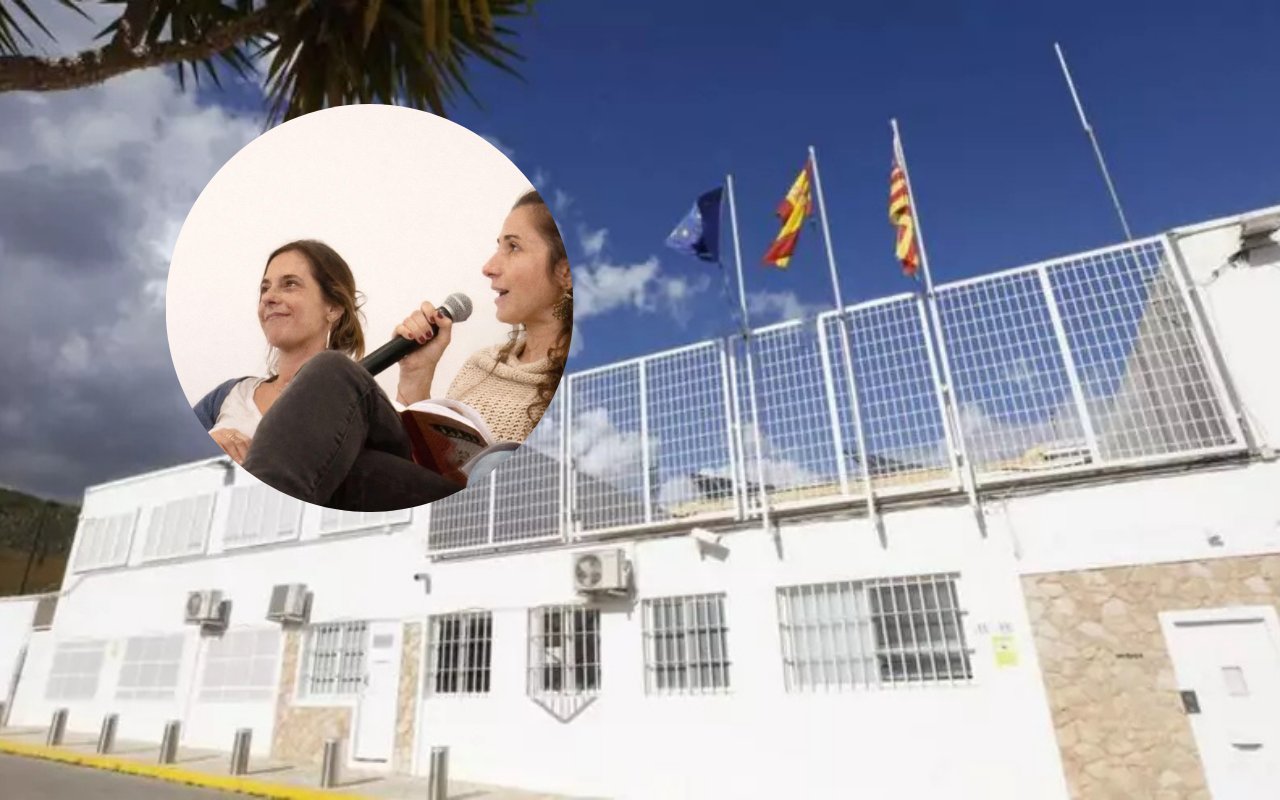
“This is the first time I don’t feel judged.” “This is the time of the week where I feel more secure”. These are the phrases most often heard in the “Speaking and Listening Circle” of Ibiza prison, a space promoted by therapists Carolina Vorburger and Chus Cabello to help inmates regain confidence in their bonds and in themselves. In recent years, this project, proposed by the Fundación Conciencia and now on pause due to lack of resources, has become one of the most valued programs of the center, according to the prison management.
A horizontal space without judgment
The circle is, in the words of its promoters, “a horizontal space in which prisoners and facilitators make room for the feelings of each person”, where the objective is to put the bonds back in the center, but from the kind, respectful and non-judgmental treatment, so that each participant can feel seen and heard.
The project was born at the request of the Fundación Conciencia, after finding that the inmates were demanding tools for self-knowledge, Carolina and Chus explained to La Voz de Ibiza. The organization contacted them because of their experience accompanying groups in spaces such as the Akademia de Ibiza or group growth programs with adolescents, areas in which they already applied listening, body and emotional regulation dynamics.
Youths with short sentences arriving by referral
Most of the participants in the Talking and Listening Circle are young men between 20 and 40 years of age, inmates in the peculiar prison of Ibiza, where they do not serve long sentences: most of them have sentences of less than six months or are awaiting trial. Many of them come to the space on the recommendation of other colleagues, the facilitators emphasize, to the point that “they are the ones who ask to enter”, attracted by the reputation of being a different place within the center.
From the first day, Carolina and Chus make an effort to explain what the circle is and what it is not: it is not a clinical therapy or a correctional program, but a safe meeting space, with clear limits and shared principles, where personal responsibility, mutual care and the possibility of relating without resorting to violence or fear are worked on.
From free speech to guided work with emotions
The weekly sessions begin with a “centering”, a kind of landing into the body so that the interns can lower the level of tension and connect with themselves. After that, a space for free speech is opened, where each one shares how he/she is, how he/she is doing, how his/her week has been. In this section, topics closely linked to daily life in prison come to the surface: waiting for trial or sentencing, resources to avoid transfers, visits from sons, daughters and relatives, or living together in the cell, which some cope better and others “terribly”, in the words of the facilitators.
Concern about “the after” also appears frequently : the exit and the fear of how to face life in freedom, they point out. Along with this, moments are introduced to work on gratitude, towards oneself and towards the shared space itself, which allows them to “recapitulate positive things” in the midst of a routine marked by the harshness of confinement. “Everyone comes with what comes with them,” summarizes Chus, and there are people who repeat the same theme for weeks because they still can’t let go of it.
In a second part of the session, more guided, the work is oriented to emotions and emotional regulation. ” We are traumatized people and it is difficult for us to regain confidence in our bodies,” they explain, so the objective is to help us to respond to what happens in the present and not only to the burden of the past. In this section, emotions such as guilt, anger, sadness or fear are addressed, as well as the beliefs that condition one’s life, from the idea that “I cannot change” to the conviction that “there is no place for me outside”.
From guilt to personal responsibility
One of the most delicate points is how to deal with the crimes committed without the group getting caught up in the story of the facts. From the beginning, the circle is governed by very clear principles: to assume 100% responsibility for what happens to me, what I say and what I do, but without falling into the discourse of blame or pointing the finger at others. “We do not work with guilt or with the finger pointing outwards”, they emphasize.
When the account of a crime appears, the focus returns to the person’s present: how it feels to name it now, how he/she can see it from the present moment, what happens in the body when he/she talks about it. The first step towards personal responsibility is to look again at the subject, not only at the file or the punishable act.
Learning to set limits without violence
Carolina and Chus emphasize that the inmates take away very specific tools for day-to-day life, both inside and outside the prison. One of them is to “change the paradigm and focus”, to go from reacting automatically to asking themselves what they are feeling, to identify that “there is a lot of anger that has been covering up other emotions” and to see that, as they uncover them little by little, they feel calmer.
Another key is language: in the circle they have seen how limits can be set without aggression or judgment, with phrases such as “I have not given you my consent, I cannot support this, it’s okay for you but I am someone else”. For the facilitators, it has been “a great learning experience to see that conflicts can be dealt with through non-violent communication”, something that contrasts with the usual dynamics of many prison environments.
Regaining confidence in relationships
In a context where showing vulnerability can be perceived as a risk, the circle has given many inmates the chance to regain confidence in their relationships. ” In prison, people feel threatened, they have to show themselves to be strong, and here they have been able to feel confident through non-judgment,” the promoters point out. Many of the people who have gone through the group have childhoods in which it has been very difficult to trust someone, so experiencing a space where they don’t have to be on the defensive all the time is profoundly restorative. These experiences are part of the line of community work and accompaniment that takes place in different parts of the island.
What has surprised Carolina and Chus the most is the level of commitment of the inmates. Not just to attending the space, but to giving themselves a real chance and trusting that they can build a different life in what depends on them. “We were a group of human beings committed to self-knowledge and to stop going through the world blaming outside and reacting,” they summarize.
Highly valued project on hold due to lack of resources
Despite the impact reported by inmates and facilitators, the Talking and Listening Circle in Ibiza prison is currently on hold. The funding from the Fundación Conciencia has run out, which has decided to reorient the program towards individual accompaniment, they explain. The prison, however, has told them that “they would like it to continue” and that it has been one of the most valued programs of the last eight years, Carolina and Chus point out. This situation reopens the debate on how emotional care projects are financially sustained in contexts of deprivation of liberty, an issue that is also present in other social policy news.
After years of volunteering with young people, the two promoters demand that this work be recognized as part of their profession and not only as militancy. To give continuity to the proposal, they have launched the association Acción Karuna, Acompañamiento consciente y comunitario, with which they are seeking public or private funding to reopen the circle in the prison of Ibiza and expand its scope.
Meanwhile, the echoes of those who have been there continue to resonate in their words: “It’s the first time I don’t feel judged” and “this is the time of the week where I feel the safest” sum up, perhaps better than any report, what was at stake every Tuesday for them. The day that many inmates pointed to as “the most important day of the week.”