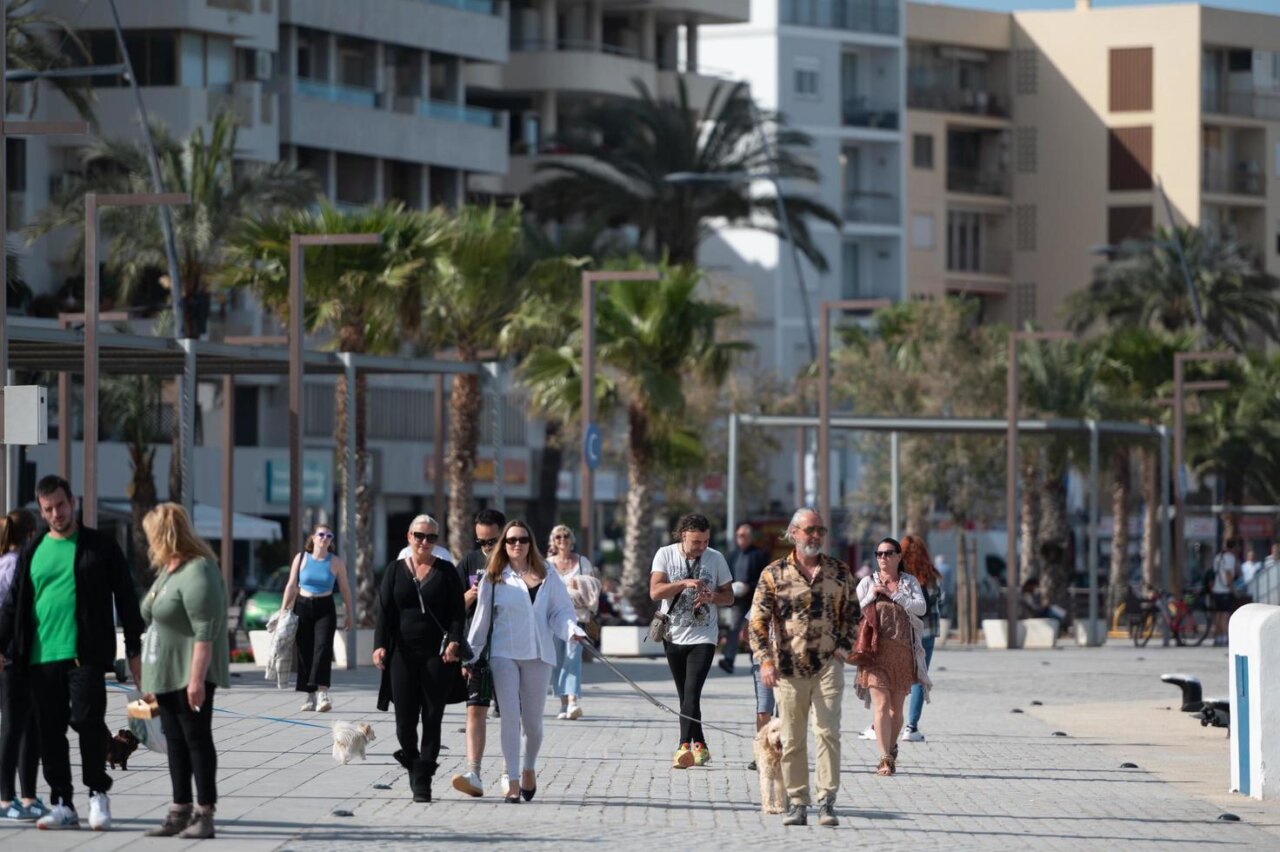
Ibiza registered a growth of 2.6% in 2024, which placed it as the ninth Spanish municipality with the highest relative population increase among the main cities, according to the first data of the INE’s Annual Population Census 2025. This advance reinforced the upward trend of the archipelago, whose population reached 1,249,844 inhabitants on January 1, 2025, an increase of 1.5%, above the national growth(1%). The Balearic Islands thus became one of the fastest growing communities, behind only the Valencian Community.
-
Ibiza and Formentera boost population growth in the Balearic Islands in the face of a plummeting birth rate
-
How much did the population increase in Ibiza in the last year?
The regional balance reflects that 622,673 men and 627,171 women reside in the archipelago, a balanced distribution that is also observed in Palma, where the population amounted to 443,196 residents, with 216,938 men and 226,258 women. This gender distribution confirms demographic stability, one of the indicators used by the INE to measure long-term trends.
By islands, Mallorca reached 971,068 inhabitants, Menorca reached 102,821, Ibiza rose to 164,265 and Formentera closed at 11,690 residents. All the islands increased their population with respect to 2024, a behavior that consolidates the cycle of growth initiated in recent years. Ibiza, moreover, is once again one of the most dynamic island territories.
The recent evolution shows a continued increase: 1.18 million in 2021, a similar figure in 2022, 1.2 million in 2023 and 1.23 million in 2024. The provisional figure for 2025 confirms this trend, which INE technicians link to the migratory balance and internal mobility between communities.
In terms of population structure, those over 64 years of age represent 16.8% of the population in the Balearic Islands, a proportion below the national average. This moderate weight of aging places the archipelago among the regions with the youngest population, although with an upward trend in recent years.
Spain exceeds 49.1 million and marks a new all-time high
Spain closed 2024 with 49,128,297 inhabitants, after increasing by 508,602 people, a growth driven mainly by the foreign population, which added 409,689 more residents (+6.3%), to a total of 6,911,971, the highest record to date. This increase reinforced the trend of recent years, in which the demographic contribution came mainly from migration.
The largest foreign groups continue to be Moroccans (968,999), Colombians (676,534) and Romanians (609,270), while the largest increases corresponded to Colombians (+98,057), Venezuelans (+52,555) and Moroccans (+48,306). This pattern confirms the growing weight of Latin America and the Maghreb on the Spanish demographic map.
By communities, the largest absolute increases were in Catalonia, Valencia and Madrid, while in relative terms the Valencian Community (2%), Madrid and the Balearic Islands (1.5%) stood out. The archipelago was once again among the most demographically stressed territories, a central aspect in the debates on housing and public services.
The INE details that 40.9% of the population lives in municipalities with more than 100,000 inhabitants, 27% in towns of between 10,001 and 50,000, 16.6% in municipalities of up to 10,000 and 2.9% in towns of less than 1,000. Ibiza, with its 2.6% growth, appears in the national ranking as one of the large municipalities with the greatest population expansion in 2024.