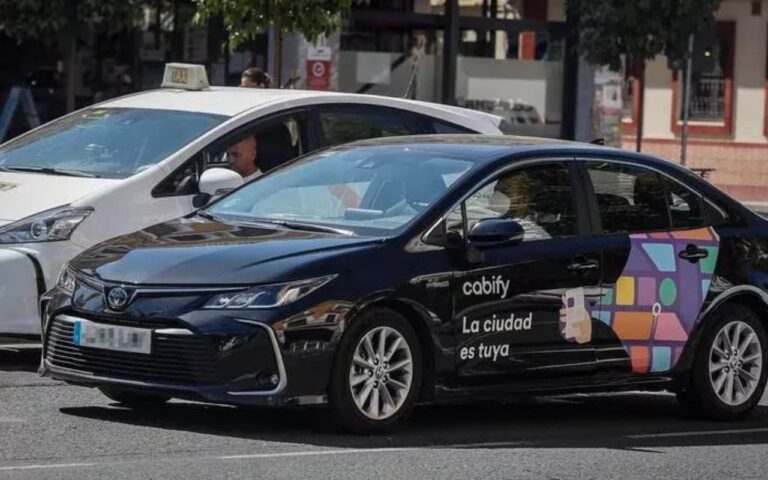

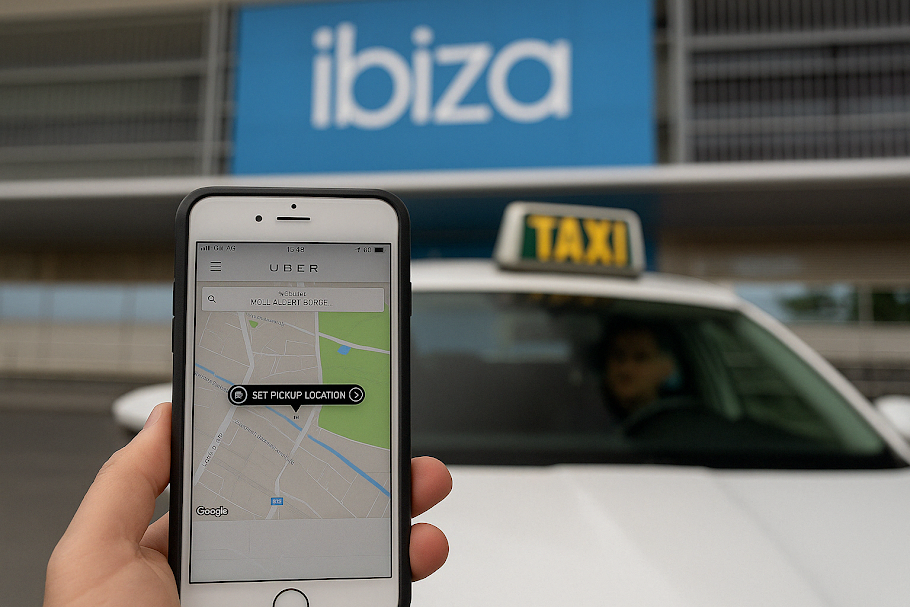
The Taxis-Pimem group has asked the Balearic Government to deny the concession of nearly 10,000 VTC licenses in the Islands, considering that their entry into the market would be «a hecatomb» that could cause the «absolute bankruptcy» of the current transport model.
-
Ibiza is put on guard: cab fears a domino effect of VTC that reinforces Uber after the latest ruling
This was stated by the president of the entity, Gabriel Moragues, after the meeting held this Wednesday at the Consolat de Mar with the president of the Govern, Marga Prohens, and the councilor of Housing, Territory and Mobility, José Luis Mateo.
According to Moragues, of that package of authorizations about 3,500 would correspond to Mallorca and about 6,500 to Ibiza, which, in his opinion, would make the Balearic system «unsustainable» from an economic, road and environmental point of view. Applications were submitted in recent years, especially after the European ruling that questioned the fixed ratios between cabs and VTC, and were frozen with the so-called «anti-Uber law», which suspended new authorizations pending a new regulatory framework.
This Wednesday’s meeting has served to evaluate the recent ruling of the High Court of Justice of the Balearic Islands (TSJIB), which forces the Government to process again 600 VTC applications in Mallorca that had been denied during the last legislature, considering that the Administration applied the ratio of VTC per cab in an arbitrary manner. It is precisely this judicial logic that makes the sector fear a «domino effect» on the rest of the files.

«A mafia» and a «speculative» model.
Moragues has charged harshly against the business behind these authorizations. According to him, many of the licenses would have been transferred shortly after being requested and would have had to overcome a judicial process to be placed now in the prelude to the concession.
«It is a mafia and it is not understood that the State Attorney General’s Office has not intervened,» he said, considering that it is «speculating with a public asset» such as transport authorizations, and that the same vehicles have even been used to apply for licenses in different autonomous communities.
The leader of Taxis-Pimem argues that three or four large companies concentrate the majority of VTC licenses at the state level and warns that, if the floodgates were opened in the Balearic Islands, they could take over a dominant position in the archipelago as well.
Uber and the platforms are being singled out
Although he insisted that cab drivers are «willing to coexist» with digital platforms, Moragues has accused these companies of engaging in «piracy» and committing irregularities, such as stopping on the promenade, wandering in search of customers or capturing passengers freehand, competing directly with the cab service.

He has put the focus on Uber, to which he reproaches a pricing policy that, as he said, lowers rates in winter to place them below those of the cab, but comes to charge «four times more» in summer, thanks to the flexibility that gives its dynamic pricing system. Against this, he has claimed that the cab works with regulated rates and needs to «fill the pantry in summer» to be able to maintain the service during the winter.
«This is an unpresentable thing for a sector that needs to fill the pantry in summer to make the service sustainable in winter,» he lamented, adding that in Palma 40% of the fleet is stopped 12 days a month in low season to be able to «share the hunger».
Despite the criticism, Moragues assured that the sector has not generated problems of social peace and defended that cabs and VTCs can provide services to different audiences, but calls for «clear rules» and limits to the growth of the platforms.
A key debate for Ibiza
The warning of Taxis-Pimem has a direct reading in Ibiza, where, according to the calculations of the association, about 6,500 of the nearly 10,000 applications on the table are concentrated. It is not the first time that figures of this caliber are handled: different employers’ associations and Moragues himself had already pointed out that in the Balearic Islands more than 10,000 VTC requests were registered, and that «more than 7,000» corresponded to the island of Ibiza and Formentera.
In addition, the Consell de Ibiza faces 89 open court cases for VTC licenses and received in 2024 applications for 16,354 new authorizations, of which only 365 were approved and the rest were denied or suspended. On top of that mountain of files is now superimposed the doctrine of the TSJIB, which questions the refusals based automatically on a ratio between cabs and VTC, without a detailed justification of general interest.
At the same time, the Government has extended the moratorium that freezes new cab and VTC licenses until the new sector regulations are approved, with the declared intention of avoiding an avalanche of authorizations while the model is being redesigned.
In this board, the pressure of Taxis-Pimem adds a new piece: the sector demands that the Executive rush to the maximum legal loopholes to deny the bulk of the nearly 10,000 licenses at stake, arguing that, otherwise, the system would collapse and the space would be in the hands of a handful of large operators and platforms such as Uber.