The High Court of Justice of the Balearic Islands (TSJIB) has established that the Administration must guarantee that families can choose, in their municipality or school area, at least one center supported with public funds where the vehicular language is not only Catalan. In Ibiza, the reality is far from that standard: the bilingual offer is concentrated in
What the TSJIB says
The three key rulings of the TSJIB -247/2024, 404/2025 and 426/2025- go in the same direction: they reject importing to the Balearic Islands the model of 25% minimum hours in Spanish set by the Catalan courts and accept, in the abstract, the model of linguistic conjunction of the LEIB, which allows Catalan to be the majority language in the classrooms.
But at the same time they set a clear limit: the conjunction cannot remain an empty formula. The Court warns that there would be a problem if, in practice, all the options available to a family were centers where the only vehicular language is Catalan.
In this case, he says, the Administration must guarantee that there is at least one center supported with public funds -preferably public- in the municipality or school zone where Castilian is also the language of instruction, and use its supervisory powers to make this possible even if it clashes with the autonomy of the centers.
The reality in Ibiza: a pilot plan in the subsidized education system and a vacuum in the public network
On paper, the Govern’s star instrument to visualize the conjunction is the Voluntary Pilot Plan for Free Choice of Language, approved in 2024 and developed from the 2024-25 school year. The program allows publicly funded schools to offer families the possibility of teaching certain core subjects (such as Mathematics or Knowledge of the Environment) in Catalan or Spanish, while maintaining a minimum of 50% of the timetable in Catalan.
In practice, however, deployment has been very limited and has been concentrated in the public network:
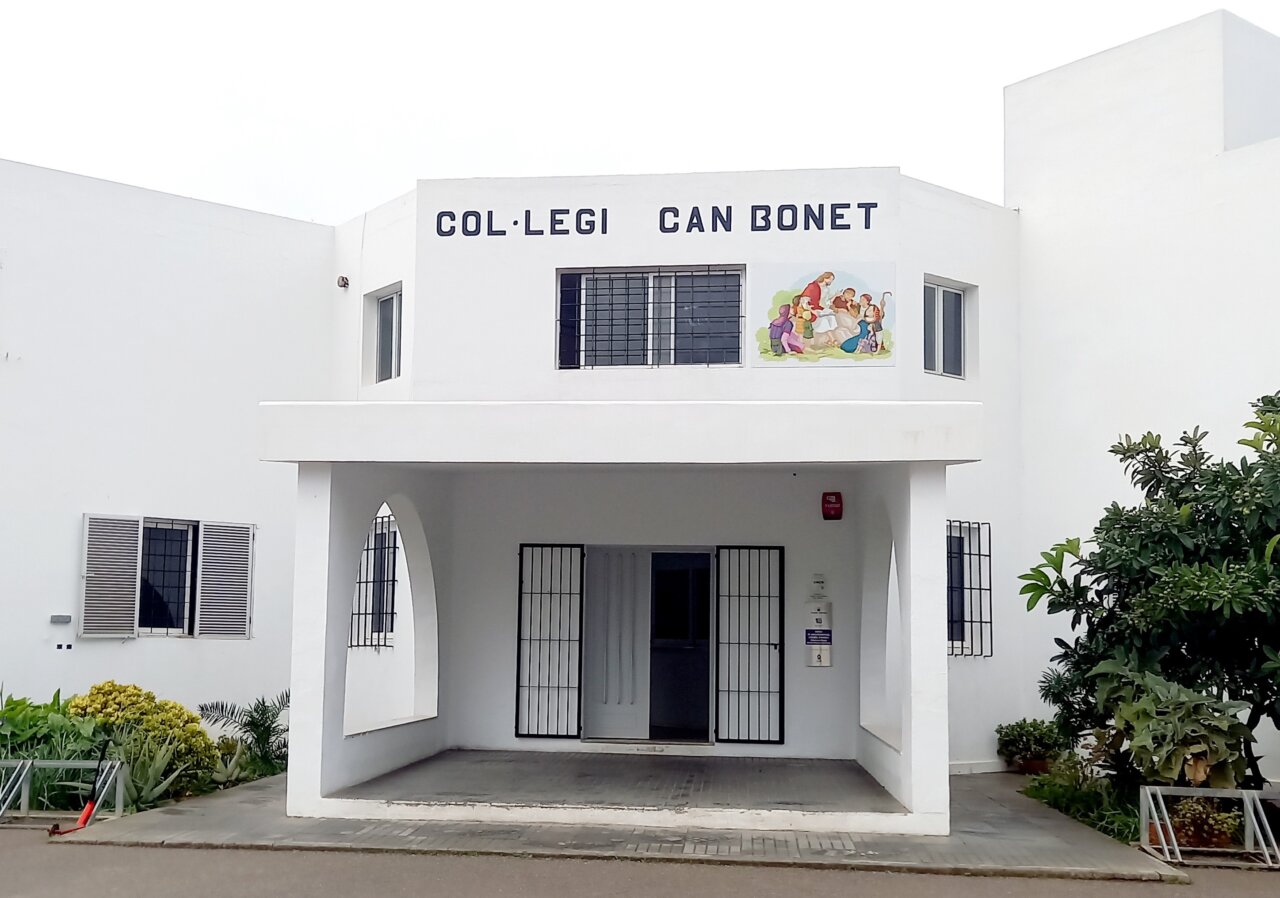
- Course 2024-25: eleven centers of the Balearic Islands adhere to the plan, all of them subsidized and none public, including three schools in Ibiza: Can Bonet (Sant Antoni), Mare de Déu de les Neus (Sant Jordi) and Nuestra Señora de la Consolación (Ibiza). According to data published by the Conselleria itself and collected by La Voz de Ibiza, 597 students from three public schools on the island participated that year in the free choice of language plan.
- Year 2025-26: the Government reported that 19 centers have applied to join the plan in the different stages; among the new applications is the Sa Real school, also subsidized, in Ibiza.
However, there is no public school or high school in Ibiza among the centers adhered to the Pilot Plan.
In addition, the Conselleria has not made public a list of public schools that, outside the pilot plan, significantly teach non-linguistic subjects in Castilian as a vehicular language. As far as families are concerned, the only visible and structured offer of education in Spanish as a vehicular language is concentrated in four schools in Vila, Sant Antoni and Sant Jordi.
That is to say, in municipalities such as Santa Eulària des Riu or Sant Joan de Labritja, families cannot opt for any center supported with public funds within their territory where they can school their children in a model in which Spanish is a vehicular language.
Offer real options
For the teachers’ association PLIS. Education, please The key is not in the 25% -which the TSJIB expressly discards- but in the Government’s obligation to create a real network of bilingual centers.
In an interview with this newspaper, its spokesman Julián Ruiz-Bravo summarizes the practical scope of rulings 247/2024, 404/2025 and 426/2025:
- The TSJIB does not recognize an automatic right for the specific center where the student studies to change its linguistic project, nor does it impose a fixed percentage of Spanish.
- But it does say that the Administration must guarantee that, in each municipality or school zone, there are enough centers supported with public funds -and it especially emphasizes the public ones- where Catalan and Spanish are vehicular languages, without expelling Spanish from the classroom.
- And he recalls that the autonomy of the center “is not absolute”: if it conflicts with the right of parents to bilingual education, the latter must prevail.
According to Ruiz Bravo, this has very concrete consequences: the Conselleria should indicate which centers in each municipality really offer a bilingual model, publish that list before the admission period and allow parents who choose those centers to have priority for linguistic reasons.
PLIS is categorical about the Pilot Plan. It defines it as a “trompe l’oeil” because:
- is voluntary and depends on the will of each faculty,
- In its first editions, it was only applied in subsidized centers,
- and, in no case, has it been proposed as a direct response to the obligation to guarantee a minimum network of bilingual centers per municipality.
Ruiz Bravo admits that the rulings are recent and that, in a reasonable interpretation, the measures to adapt could be deployed for the next academic year, when the student admission period opens. But, as of today, the Conselleria d’Educació i Universitats has not announced any change in that sense nor has it advanced that it is going to indicate bilingual centers by municipalities or to give priority of access to the families that choose them for linguistic reasons.
The Government’s position
In fact, the Conselleria maintains that its policy is already in line with what the justice system demands. In a first response to this newspaper, the department stressed that “the TSJIB rejects that 25% of the teaching time is taught in Castilian and that some educational centers establish Catalan as the only vehicular language does not imply the constitutional bankruptcy of the Balearic educational model” and that the ruling “supports that the model of linguistic conjunction applied in the Balearic Islands is correct”.
The Regional Ministry also insists that its obligation is that, at the end of compulsory education, all students should be proficient in both languages, and points to other compensation mechanisms: the right to receive their first education in the official family language, language welcome programs for late entrants, specific reinforcement, etc.
However, the Government has not confirmed initiatives, beyond the pilot plan, to territorially guarantee the existence of centers -public or subsidized- where Spanish is also the vehicular language.
The Govern defends the Voluntary Pilot Plan of Free Choice of Language as proof that new options are being offered and recalls that participation is growing. But it has not announced any specific plan to incorporate public centers into the program, nor to identify and publicize which centers meet the standard that the TSJIB itself links to the validity of the conjunction model.
Ruiz-Bravo disagrees: “If the Administration says that it is not bound by this ruling, it is telling a lie. The ruling is very clear.