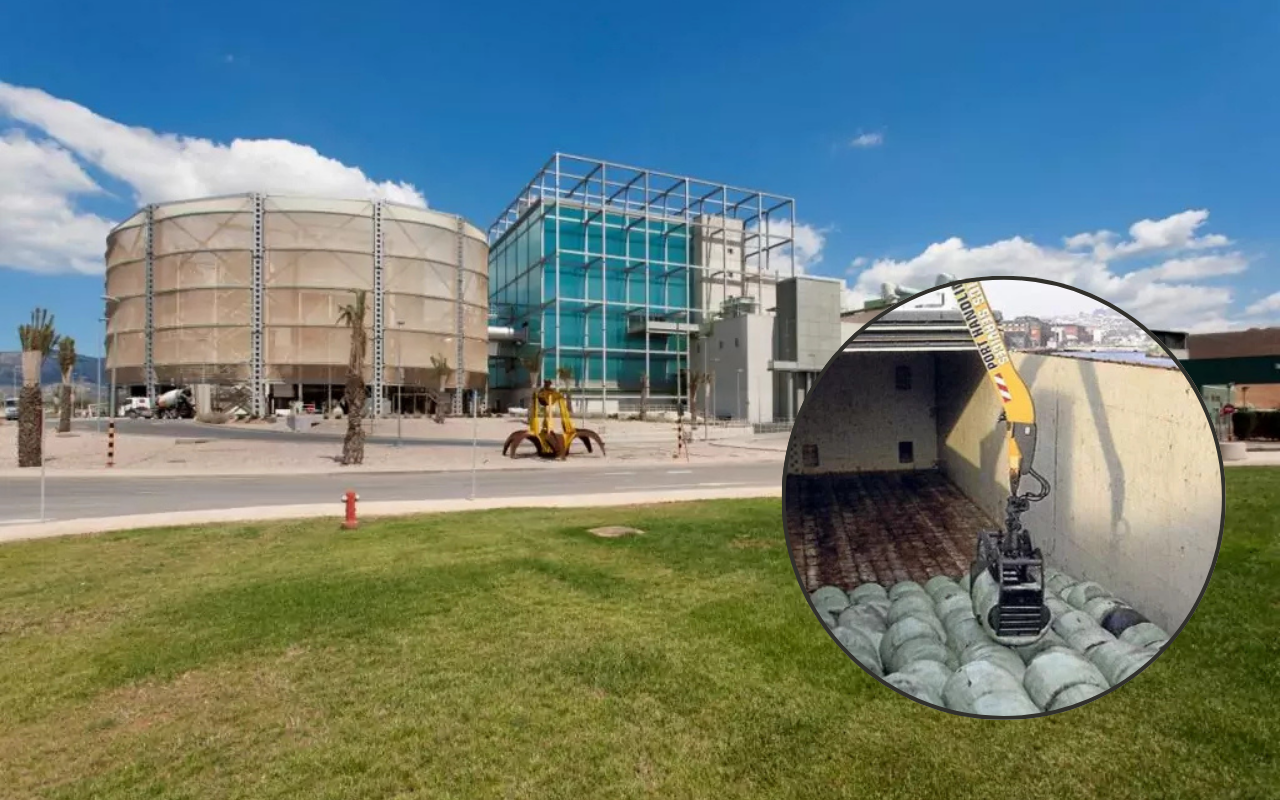
Ibiza already has political clearance to start sending to Mallorca the waste that until now was dumped in Ca na Putxa, a temporary exit marked by the exhausted useful life of the island landfill and by the agreement between the councils and the Govern. The new decree of acceleration of strategic projects, validated at the second attempt, shields the legal coverage of the transfer and configures this movement of the Ibizan garbage as an exceptional measure, with previous pilot test and an aid of 50 million to the Consell de Mallorca.
Relocation unblocked after weeks of negotiation
The decree specifies that, among other measures, it grants legal coverage to the agreement reached between the island councils and the Govern to transfer waste from Ibiza to Mallorca on a temporary basis, a pact adopted before the end of the useful life of the Ca na Putxa landfill. With the new regulation in force, the shipment of the waste fraction can begin “immediately and legally”, always within the framework of the agreement signed by the two island institutions.
This agreement will allow the councils of Ibiza and Mallorca to agree on the eventual conditions for the transfer of waste, so that the administrations involved will be the ones to define the practical operation of this solution: what is sent, for how long and under what administrative rules. On the table, as has been explained in recent weeks, is the waste fraction that today ends up in Ca na Putxa and will be treated in the Mallorcan plants.
-
Ibiza will promote a shock plan to reduce waste while the pilot transfer to Mallorca gets underway
-
What it would be like to move garbage from Ibiza to Mallorca: the pilot plan the Consell is working on
Pilot test and $50 million grant to treat garbage
Before the final implementation of this initiative, the decree provides for a pilot test to be carried out prior to the regular operation of the system. The objective is that, during this period, the institutions can adjust the waste transfer device between Ibiza and Mallorca and check its operational and economic fit.
In return, the text establishes that the Consell de Mallorca will receive an aid of 50 million euros from the Govern, a contribution that will be distributed in ten annual payments. This item is intended to meet the expenses derived from receiving and treating in Mallorca the waste that until now went to the landfill of Ca na Putxa, in a context in which the receiving island will assume part of the pressure of the waste management system of Ibiza.
Renewables left out of the fast track to save the decree
The unblocking of the waste transfer comes after a long political struggle around the acceleration decree itself, which failed in its first attempt of validation last September 30 due to the vote against Vox. After that veto, and with the failed vote on the spending ceiling in the middle, the Govern resumed negotiations with its partner, which conditioned its support to eliminate the possibility that renewable energy projects could benefit from the accelerated route.
In the new text, renewable projects are outside the acceleration procedure and must be processed through the ordinary route, a modification that Vox considers key to have lifted the blockade. Its spokesperson, Manuela Cañadas, has congratulated herself for having eliminated what she describes as the “Trojan horse of the 2030 Agenda” and for the “radical purification” of a decree that, in her opinion, originally “only sought to favor renewable energies”.
From the PP, the deputy Jordi López has defended that the new regulation will put an end to “excessive bureaucracy” that for years has slowed down projects, assuring that neither controls nor guarantees are eliminated, but rather duplicities and procedures that “paralyze and stifle economic initiative”.
Opposition criticisms: environment and investment model
The left-wing groups have voted against the decree and have focused much of their criticism on the concessions to Vox in environmental matters. The socialist Llorenç Pou has reproached the Govern for having eliminated all the environmental measures that the first version of the text contemplated, accusing the Executive of moving “always its red line backwards, backwards and backwards” and qualifying as “illuminatis” the idea of transforming the economic model only with this decree.
The deputy of MÉS per Mallorca, Ferran Rosa, has denounced the “negotiating incapacity” of Antoni Costa for having given in to the demands of Vox and has shown skepticism about the real benefits of the norm. In his opinion, the Govern shows “laziness” when it comes to legislating by resorting to the figure of the decree for matters that it does not consider urgent, renouncing to a wider parliamentary debate from the beginning.
From Més per Menorca, Josep Castells has described the model promoted by the decree as “very old-fashioned, that of ‘Welcome, Mister Marshall'”, based on the arrival of large investments from outside while discriminating against small and local projects. And from Unidas Podemos, José María García criticized the fact that the Government has passed the text “through the filter of climate and energy denialism of the ultra-right”, diluting the weight of the ecological transition.
Strategic projects and the role of city councils and councils
Beyond the issue of Ibiza’s waste, the decree configures a new framework for the so-called Projects of Special Strategic Interest (PEIE), both public and private. These projects may benefit from preferential processing, administrative simplification and reduced deadlines, provided they meet certain investment thresholds (from 0.5 million in agricultural projects to 10 million in other sectors) or the creation and maintenance of stable employment.
The text also regulates the Strategic Project Accelerator Unit (UAPE), which will act as a technical support unit for private PEIEs, and eliminates the two-year expiration of the PEIE declaration in the public sector, extending this figure to the entire autonomous and insular public sector, including foundations.
At the local level, the decree maintains and simplifies the strategic declarations of Palma and Ibiza and opens the door for the rest of the municipalities and councils to request the declaration of PEIE for investments in water cycle, energy efficiency or waste treatment, an instrument that, on paper, could be used to strengthen the island’s own waste management infrastructures beyond the temporary shipment of the waste fraction to Mallorca.