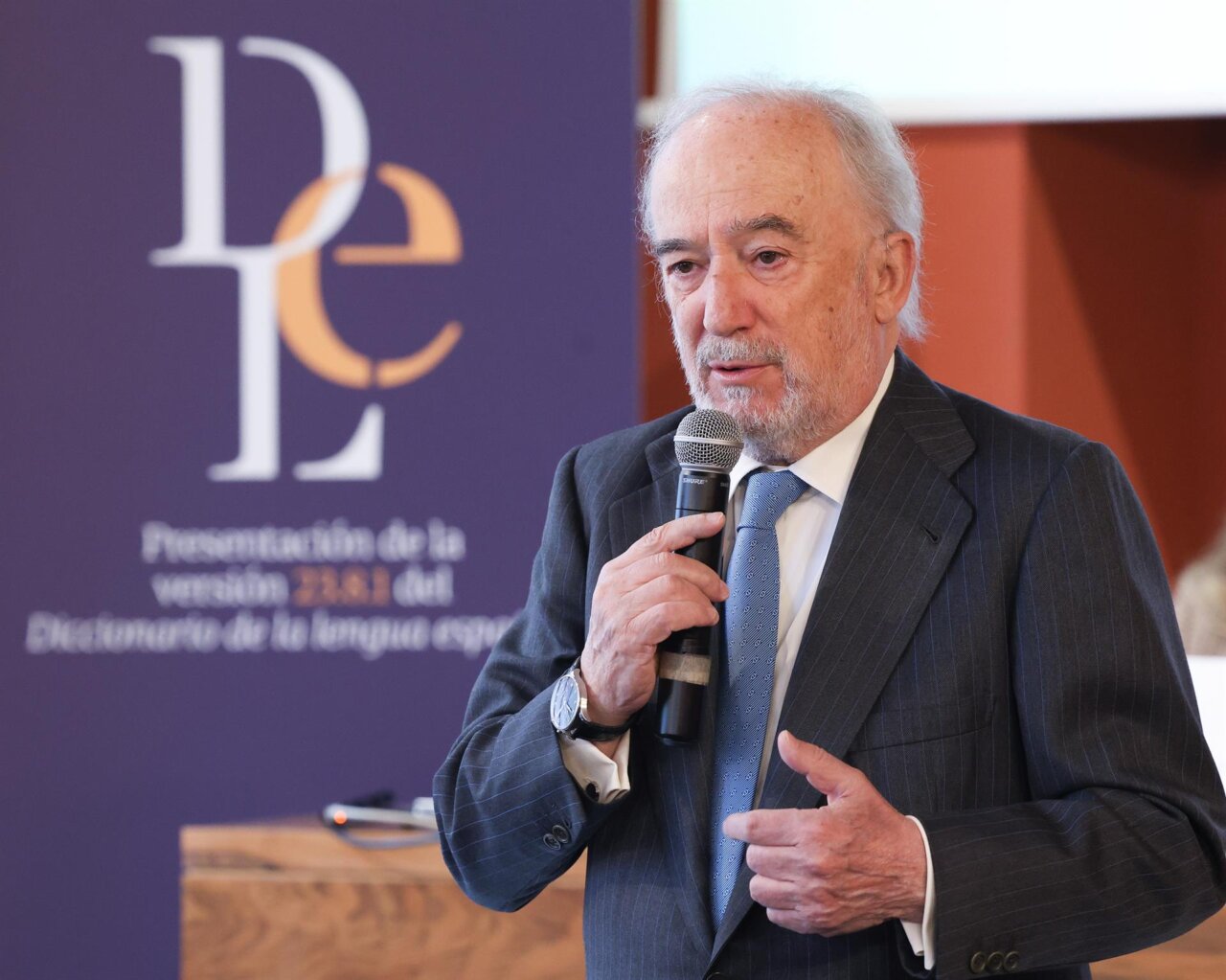
The Dictionary of the Spanish Language (DLE) has incorporated new words and meanings in its electronic version 23.8.1, among which are terms of social and colloquial use as ‘mena’, ‘farlopa’, ‘bocachancla’, ‘turismofobia’ or ‘braguetazo’. The update was presented this Monday by the head of the Institute of Lexicography of the Royal Spanish Academy (RAE), Elena Zamora, and includes a total of 330 novelties.
The additions include new terms and expressions, as well as new meanings of existing words, amendments to previous articles and some deletions. Zamora stressed that this revision does not constitute a complete update of the Dictionary, as was the case in previous years, but rather a preview of the academic work that precedes the publication of the 24th edition of the DLE, scheduled for next year.
“This set of new features of the Dictionary in the format of the third edition that we are now presenting is not a complete update, but a sample of the academic work prior to the new edition,” explained Zamora during the presentation, in which he highlighted the continuous process of revision and adaptation of the Dictionary to social, cultural and linguistic changes.
Among the new additions are terms from diverse fields such as science, health, the environment or technology, as well as words that have emerged from colloquial use and social debate. This is the case of ‘farlopa’, included as a colloquial synonym for cocaine; ‘bocachancla’, defined as a synonym for “big mouth”; or ‘braguetazo’, a colloquial term that refers to “marriage for interest with a rich person or a person of a higher social class”.
It also incorporates the acronym ‘mena’, corresponding to unaccompanied foreign minor, defined as a minor immigrant who does not have the care of any person responsible for him/her. The update also includes an amendment of meaning that includes its use in a derogatory sense, thus reflecting the evolution and the social charge that the term has acquired in certain contexts.
Along with the entry of new words, the DLE expands the meaning of other existing words. This is the case of ‘directo’, which incorporates a meaning referring to a radio, television or online broadcast that is transmitted at the same time as it is performed, as well as a meaning specific to the field of boxing, where it designates the punch that is given by projecting the fist forward in a straight line.