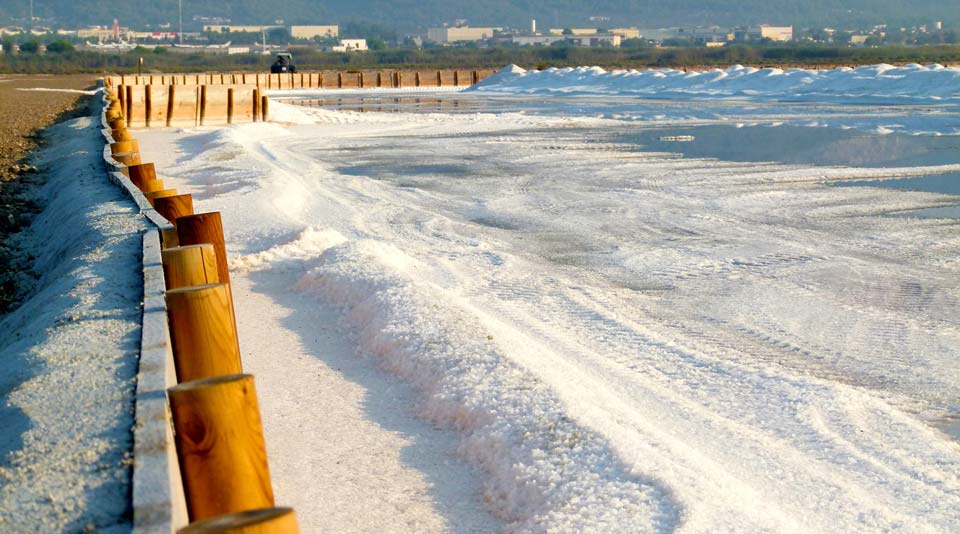
The salt mines of Ibiza have concluded this year’s campaign with a salt harvest that will be close to 50,000 tons, a balance that those responsible consider positive despite the heavy rains in September and October, which forced to stop the activity for almost six weeks in the middle of the harvesting season.
In just twelve days, the facilities received about 450 liters of fresh water per square meter, an unprecedented volume in the recent memory of the operation. These precipitations caused the loss of about four centimeters of thickness of the salt already crystallized in the ponds, significantly reducing the production forecast for this year.
The person in charge of the saltworks, Joan Ribas, explained to IB3 that the accumulation of water came to cover the motas, the separations between the ponds, which made it impossible to continue with the harvest. “You couldn’t see the motas,” he said, a situation that forced the activity to be completely paralyzed for weeks when the campaign was at its peak.
Nevertheless, the final balance was not negative. Production was 6,000 tons below last year. The initial forecast was to reach 80,000 tons, but the rains reduced the harvest to about 68,000 tons. Since there is not enough storage capacity, some 18,000 tons that could not be harvested will remain in the ponds for next season.
Added to this scenario is the impact of climate change on international demand. The lack of snowfall has reduced the need for road de-icing salt in the United Kingdom, one of the usual markets, which has generated a surplus of some 26,000 tons with no immediate outlet.
The highest quality salt does maintain its assured destination. The Faroe Islands, where it is used for salting fish, will once again be the main customer. Until September of next year, around 40,000 tons will be sent to this market, thus guaranteeing the commercialization of the most select product of the Ibizan salt pans.