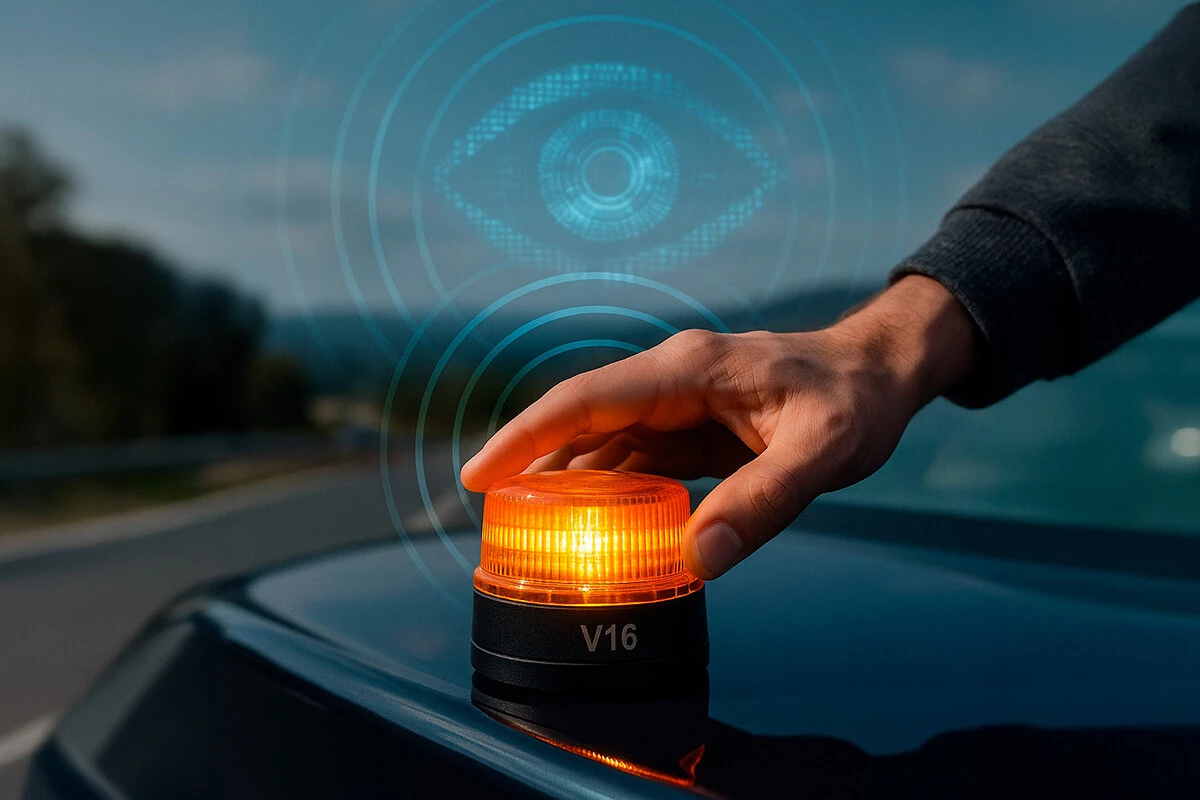
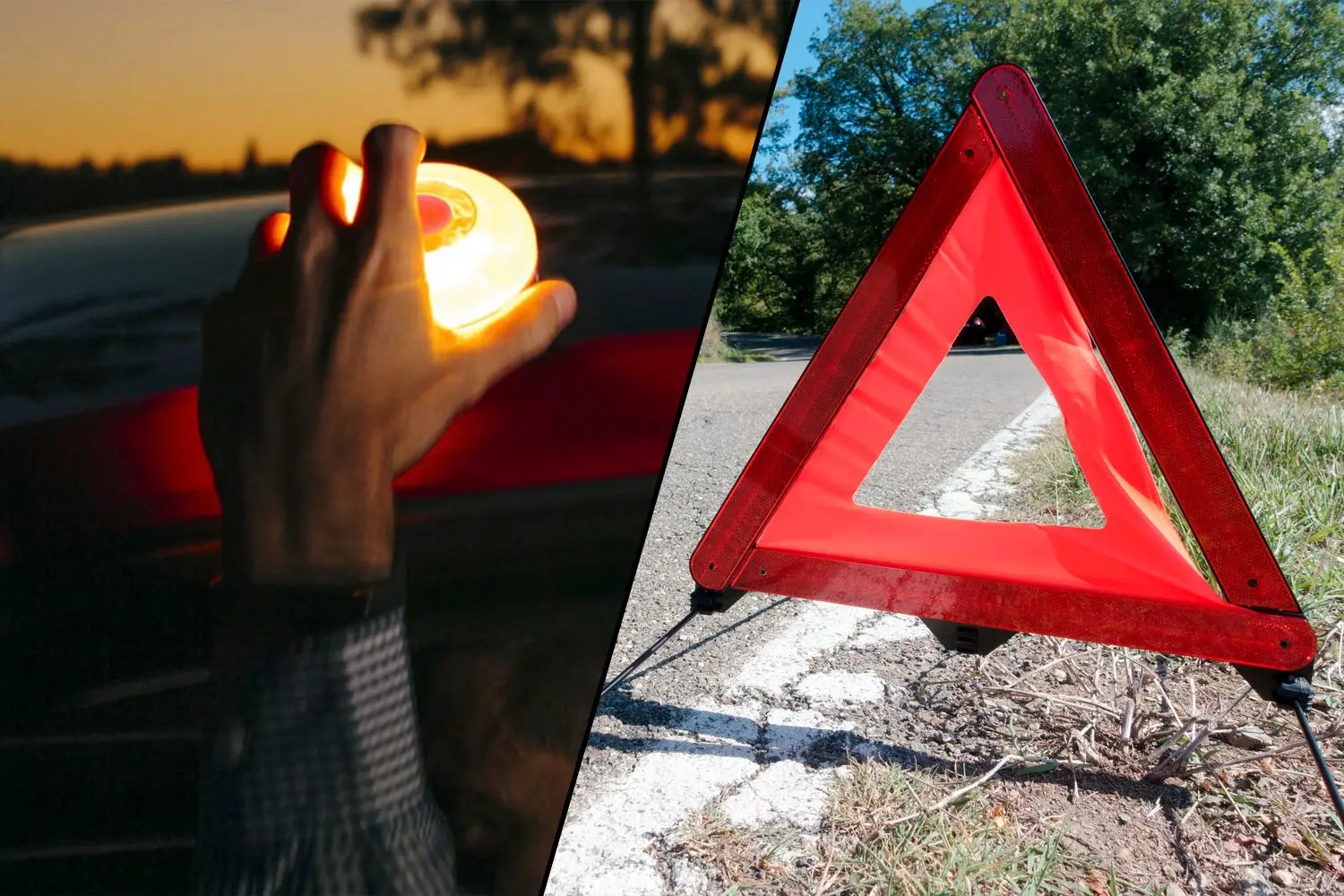
As of January 1, 2026, all drivers will have to carry a V-16 beacon in their cars to signal stops due to breakdown or accident, a measure that will come into force on a mandatory basis. However, the Guardia Civil de Tráfico has issued an important warning: these devices are not always effective in all circumstances and must be supplemented with the traditional triangles in specific situations to avoid additional risks.
The V-16 Beacon is mandatory, but is it enough?
The V-16 Beacon was designed to replace emergency triangles and improve the signaling of vehicles stopped on the shoulder. The device emits a high-visibility light that is activated in the event of a breakdown or accident, with the intention of alerting other drivers and reducing the risk of secondary collisions.
However, following a recent rescue of an accident vehicle on a curve, Edi García, a firefighter with the Valencia Provincial Fire Department, pointed out a significant limitation of V-16 signaling: “It won’t be seen on a gradient change in daylight, and neither will it be seen on a curve”. As he explained, if the flashing of the beacon is not perceptible in time by approaching drivers, it may not be enough to prevent a major accident.
Therefore, Garcia stressed that, “it is fine as something additional, but additional,” emphasizing that the exclusive use of the beacon may not be sufficient in all circumstances on the road.
The Civil Guard’s position: more elements, more security
The Guardia Civil de Tráfico has been clear in this regard: it is not enough to rely solely on the V-16 Beacon. Olaya Salardón, spokesperson for the Unified Association of the Civil Guard, has pointed out that it is important to maintain the use of the classic triangles and other signaling elements, especially in special conditions, because “the more elements that serve to signal an obstacle, an accident or a breakdown and protect us the better”.
The Armed Institute has remarked that the triangles can be especially useful in:
-
Curves
-
Changes in elevation
-
Moments of light change
It was also noted that these classic devices operate without the need for a battery or batteries, unlike the V-16s, which require power to emit the light signal.
Triangles and V-16: yes or no?
One of the concerns that has arisen with these recommendations is the apparent contradiction between the mandatory use of the V-16 beacon and the use of triangles, which will officially cease to be the primary device. However, the Guardia Civil has clarified that the joint use of both systems should only be done if the triangles can be safely placed.
This is because triangles require the driver or a vehicle occupant to get down onto the roadway to place them, which may pose a risk if traffic is heavy or visibility is reduced. Therefore, the recommendation to use triangles is limited to situations where it is safe to place them without unnecessary exposure to traffic.
Can I still use the triangles without fear?
The general director of Traffic, Pere Navarro, already expressed himself on this point in the program Más Vale Tarde: “The only mandatory thing is the V-16 from here do what you want. This is to replace the triangles because it is safer, but if you want to place them yourself”.
This official statement confirmed that those who use triangles will not be fined, as long as they do so in a safe and complementary manner to the V-16 beacon. Navarro made it clear that the intention of the regulation is to improve road safety, not to penalize drivers who choose to signal the incident additionally.
Criticism from drivers and associations
Not everyone agrees with the Guardia Civil’s recommendations. Mario Arnaldo, president of Automovilistas Europeos Asociados, has expressed concerns about the use of the triangles: “It is not complementary. This (the triangles) entails an enormous risk that a pedestrian may be driving on a road where he/she can be run over”.
This point of view highlights the main argument against the use of triangles: their placement on the shoulder or on the roadway may imply a risk for the driver himself or the occupants of the vehicle, especially on roads with high speed or low visibility.
What do experts say about the effectiveness of V-16 Beacons?
The introduction of the V-16 beacon responded to the need to improve the signaling of immobilized vehicles without the driver having to leave the passenger compartment. The beacon’s high beacon light is designed to be visible from a greater distance and to alert other drivers in advance.
However, as has been shown in cases of accidents in curves or changes in gradient, the visibility of the light can be reduced by:
-
Track orientation
-
The incidence of daylight
-
Natural or man-made obstacles blocking the view
These types of limitations have led both firefighters and the Guardia Civil to recommend caution and the use of multiple signaling resources whenever possible.