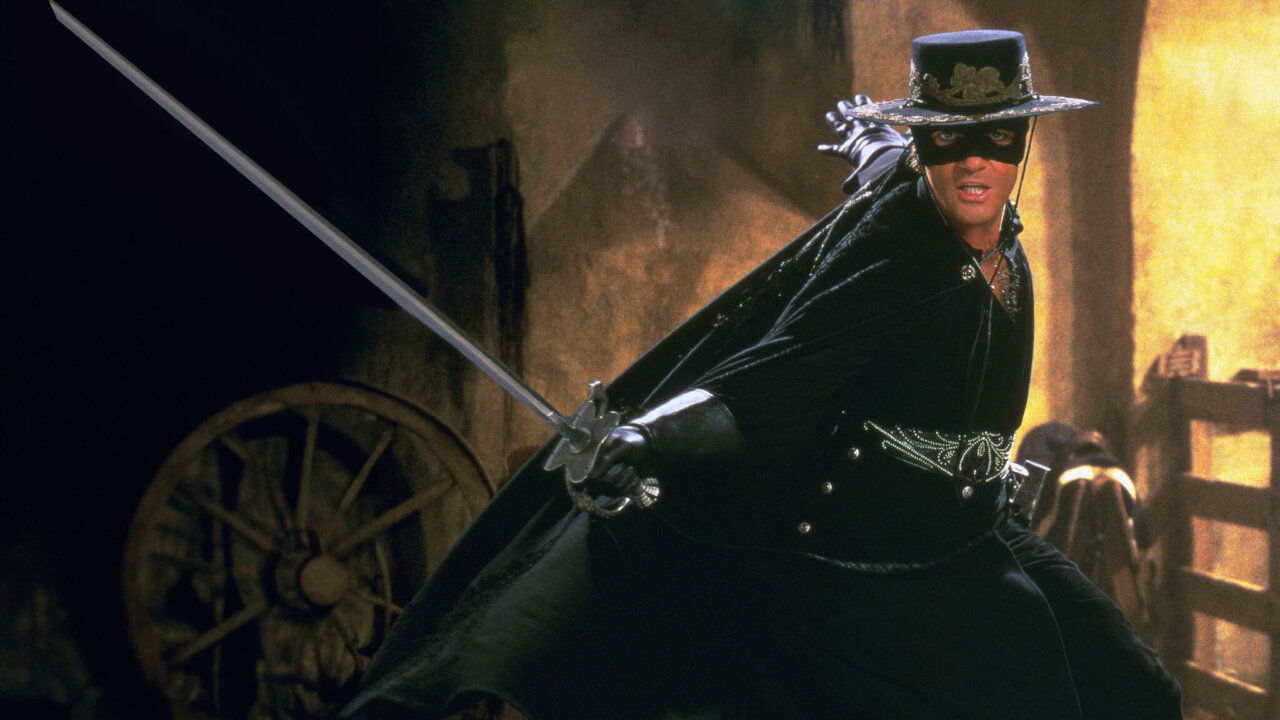
Twenty-seven years ago, an adventure film achieved something unusual: it became a phenomenon deeply felt by Spanish audiences, despite being a major international production. Directed by Martin Campbell, with screenplay by John Eskow, Ted Elliott and Terry Rossio, and based on one of the most iconic characters created by the American writer Johnston McCulley, that film had an American passport, a classic spirit and an unmistakable Spanish stamp thanks to its protagonist: Antonio Banderas.
That film was none other than The Mask of Zorro, released in 1998 and since then converted into one of the great references of modern adventure cinema. A title that today, Thursday, December 18, returns to free-to-air television and that, almost three decades later, still retains intact its entertainment capacity and its weight in the collective memory of millions of viewers.
A resounding success in Spanish cinemas
When The Mask of Zorro hit theaters, it did so on the strength of a major blockbuster. Worldwide, the film
According to data collected by the ICAA, more than 4,000,000 Spanish spectators went to the cinema to see it, a figure that placed it among the great successes of the late nineties in our country. Part of this enthusiasm can be explained by the moment Antonio Banderas was going through, already consolidated as one of the most international Spanish film stars, but also by the epic, romantic and adventurous nature of the story.
A Zorro with Spanish flavor
Although it was an American production, with New Zealand direction and an international cast (mainly British, American and Mexican), The Mask of Zorro achieved something unique: it felt close to Spanish audiences. The presence of Antonio Banderas as the protagonist was key, but not the only factor.
The film revisited the Zorro myth from a classic perspective, with echoes of swashbuckling films, westerns and great adventure films. In fact, together with its sequel The Legend of Zorro, it is considered to be the closest thing to superhero cinema that Steven Spielberg has ever made, in this case as a producer.
That balance between showmanship, tradition and charisma made Banderas’ Zorro a particularly memorable version of the character.
A story of legacy, revenge and justice
The plot of The Mask of Zorro is set in the early 19th century, after the Mexican War of Independence, at a time when the 300 years of Spanish rule in California are coming to an end. In this historical context, a story marked by betrayal, loss and the inheritance of a symbol unfolds.
Don Diego de la Vega, played by Anthony Hopkins, is the original Zorro. His identity is discovered and he is captured by his enemy, Spanish governor Don Rafael Montero ( Stuart Wilson), just as Spain surrenders California to Mexican general Santa Anna (Joaquim de Almeida). Before being imprisoned, Montero breaks into Don Diego’s villa, murders his wife and kidnaps his daughter, Elena.
Twenty years later, Don Diego manages to escape from prison and discovers that Montero has raised Elena (Catherine Zeta-Jones) as if she were his own daughter. Unable to continue fighting as before, he decides to find a successor for Zorro. That heir is Alejandro Murieta, a con man with a tragic past played by Antonio Banderas.
Antonio Banderas, in one of the greatest roles of his career.
For Antonio Banderas, The Mask of Zorro was one of the most brilliant moments of his international career. His performance combined action, charisma, irony and romanticism, definitively consolidating him as an adventure hero in the eyes of the general public.
Alejandro Murieta’s character not only learned to handle the sword and mask, but also embodied the evolution from personal rage to a greater cause: justice and the defense of the oppressed. This transformation was one of the film’s emotional linchpins and one of the keys to its success.
A luxury cast and unforgettable chemistry
Alongside Banderas, Anthony Hopkins brought solemnity and experience to the role of the original Zorro, while Catherine Zeta-Jones shone as Elena, becoming one of the great female adventure film icons of the era. The chemistry between Banderas and Zeta-Jones was one of the most celebrated elements by audiences and critics alike.
The ensemble cast, coupled with a carefully crafted mise-en-scene, great action sequences, and an epic soundtrack, finished elevating the film to the status of a modern classic.
A classic returns to television
This Thursday, December 18, La máscara del Zorro (The Mask of Zorro) will be broadcast free-to-air on Be Mad at 17:43, as part of a programming block dedicated to adventure films. In addition, at 8:21 pm, the channel will broadcast its sequel, The Legend of Zorro, allowing the audience to relive the legacy of the character played by Antonio Banderas in one complete sitting.