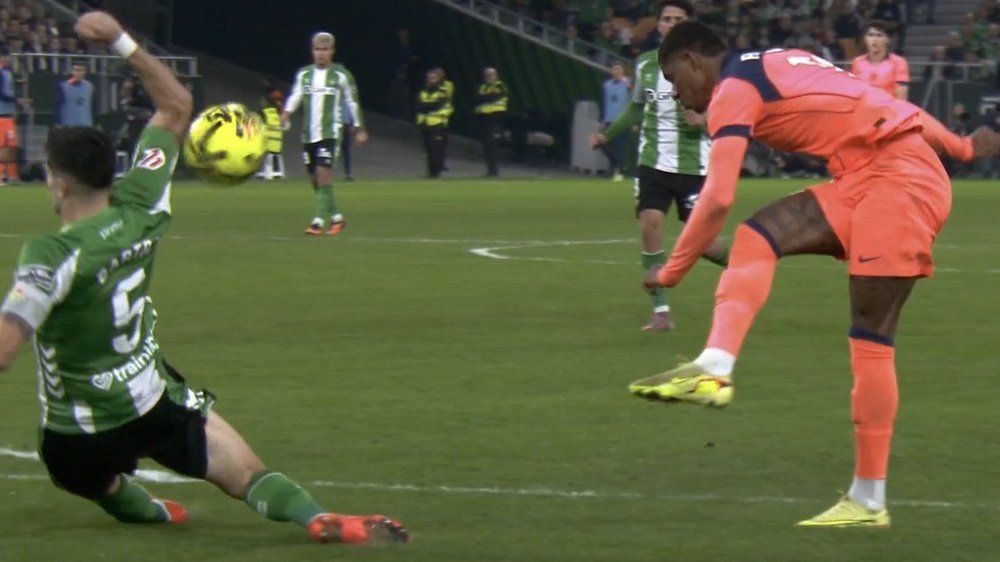
In the match between Real Betis and FC Barcelona, a shot by Marcus Rashford was deflected by Marc Bartra’s body; the ball bounced off his leg and subsequently hit his arm. At first glance, the action did not provoke significant protests, but the referee, alerted by the VAR, decided to review the play. In the end, he awarded a penalty.
The decision sparked strong displeasure at Betis and among their fans, who questioned whether the initial contact had been with the leg and not with the hand.
Referee back-up and the VAR room
The referee in charge of the play, after accessing the VAR monitor, clearly explained his criteria: “That is punishable because Bartra, from the start, is throwing his arm up. He is occupying a space from the first moment. Even if there’s a rebound on his leg, it’s still punishable and it’s a penalty, right?
The key argument: Bartra had his arm raised from the first instant and in an unnatural position, which, according to the interpretation of the rules, unnecessarily extends his body volume and can interfere with an opponent’s shot. For this reason, and despite the rebound, the handball was considered voluntary.
For the referee and those in charge of the VAR, the decision was correct, in accordance with Rule 12, which regulates hands inside the area.
CTA’s ruling: officially supported penalty
After analyzing the play in its “Tiempo de revisión” program, the Technical Committee of Referees (CTA) confirmed the sanction: Bartra’s hand corresponds to a penalty. According to the body, “the arm is in an unnatural position and occupies a space that does not correspond to him to make his body bigger”.
What’s so fucked up about Bartra’s penalty is not even that it’s whistled. It’s that the refereeing collective has complicated the rules and criteria so much that they are the only ones who understand that it is a penalty. Not even the most culé
pic.twitter.com/TSk0NUyuTp– Nácher (@JaviNacher7) December 6, 2025
The fact that the ball previously bounced off his leg does not exempt him from sanction, as the player faced the action with his arm in a potentially punishable position from the outset. The CTA stressed that this criterion must be applied uniformly to avoid future confusion and ensure consistency in refereeing decisions.
Controversy outside the technical area
For many in the Betis entourage, including their coach Manuel Pellegrini, the penalty was unfair. Pellegrini said that “I don’t think it was a penalty. It hit Bartra before… they invented a penalty to stretch the score”.
The fans and several analysts have expressed their bewilderment and discontent: for them, the play did not merit a review, much less a penalty, and they denounce an arbitrary interpretation that conditioned the result.
What are the implications of this decision for the future?
The confirmation of the penalty by the CTA brings to the table the importance of body positioning on handball inside the area. The interpretation of a raised arm, even if the ball bounces off another part of the body first, may be punishable, which increases the degree of demand on defenders in close shooting situations.
This could increase the risks of controversial penalties in the coming matchdays, especially in actions involving powerful shots or fortuitous rebounds. For many clubs and defenders, the message is clear: body position counts as much as intent.
Moreover, the controversy reignites the debate on the use of VAR and the subjectivity of the criteria: even officially endorsed decisions can provoke social discontent.
For Marc Bartra and for Betis, the play will mark a before and after: a penalty converted, a defeat marked, and a controversy that seems to have no end.