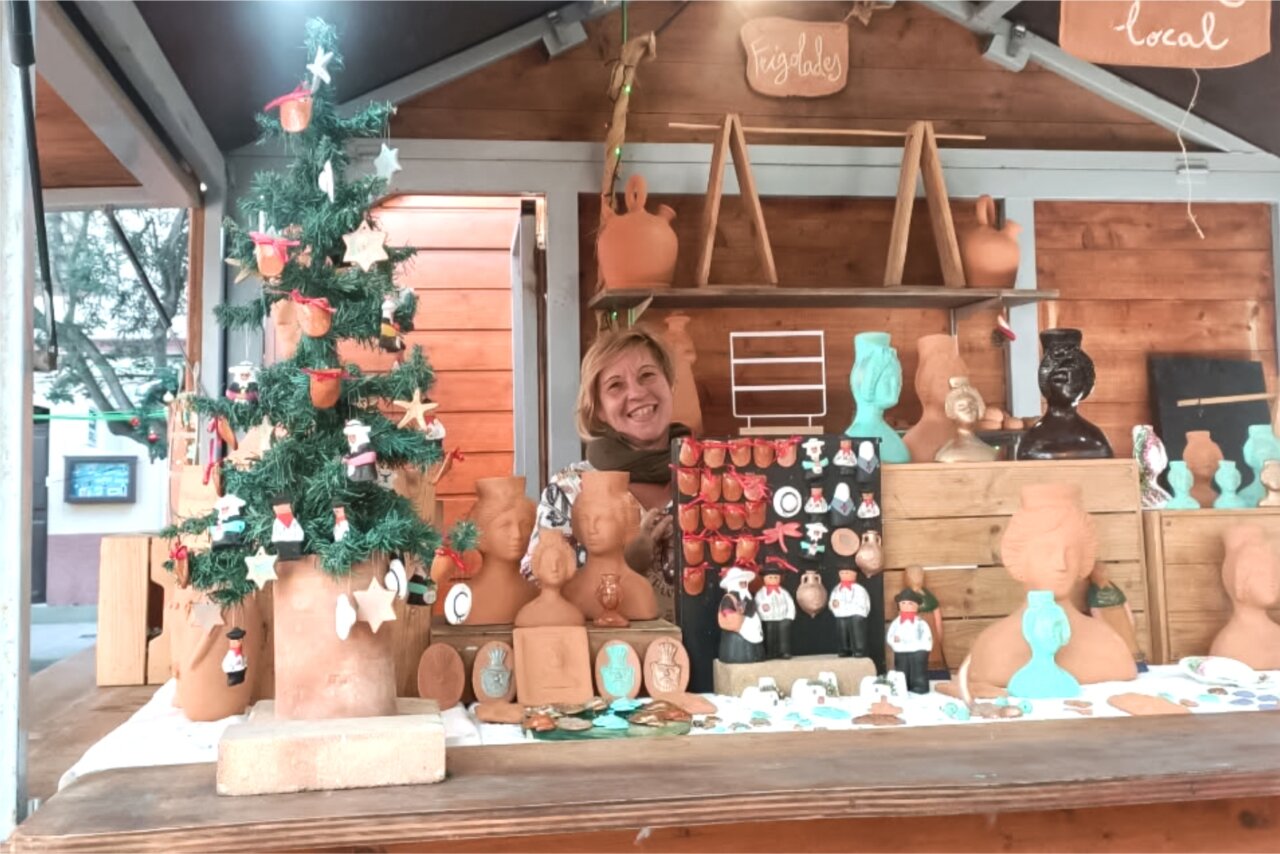
In the middle of the Christmas campaign, the Consell de Ibiza promotes the initiative “Give crafts, give Eivissa”, a commitment to local products and the value of handmade work. Among the artisans participating is María José Marí Bufí, second generation ceramist and soul of the workshop Frigolades Artesanía Ibicenca, whose work connects past and present through clay.
The daughter of a ceramist, María José has grown up among kilns, molds and glazes. Her pieces, totally handmade, drink from the history of the island, its natural environment and its most ancient symbols. Figures such as the goddess Tanit, the god Bes or the Ibizan peasant couples have become the hallmarks of a workshop that invites you to rediscover the most ancestral Ibiza.
A public that bets on local products
María José has been participating in Christmas fairs for about six years and says that during this time she has noticed a change in the public. “I am very grateful that people are looking for local products. In other campaigns there are more tourists, but now I notice that the local customer is looking for handicrafts,” she explains.
Christmas has thus become a key time to bet on gifts with meaning, as opposed to industrial production.

Each piece has a process and a story
For the ceramist, whoever chooses a handcrafted piece is looking for something more than a decorative object. “Behind each artisan there is a job, a family and a workshop,” she says. Although she uses molds in her process, she insists that each piece is unique, marked by the gesture of the hand and the manual work. This difference sometimes generates curious situations with the public.
Laughing, he recalls how a lady assured him that his pieces were not made by hand, but by mold. “I explained that yes, they are made with molds, but with my hands. I don’t touch the molds with a magic wand and the figure appears, everything takes a process,” he says.
Ceramics, heritage and Ibizan identity
Ceramics have been historically linked to everyday life in Ibiza. Until the 1970s it was a functional element in country houses, and later it acquired a decorative character. “We have a unique Punic and Phoenician heritage. Through ceramics we make known who Tanit is or who Bes is, figures that many people don’t know,” he explains. Following the line of work of her father, the renowned master craftsman ‘Frígoles’, Toni Marí Ribas, María José has incorporated a more contemporary vision, playing with color, but always maintaining the union between tradition and modernity.
At Christmas, although his most representative pieces are sold all year round, he introduces small festive nods. “I take out Ibizan figurines to hang on the tree, such as payesas, sombreritos or castanets, but people are still looking for Tanit and Bes,” he says.

The value of the Artesanía Ibiza seal
As a craftswoman registered in the Census of Crafts of Ibiza, María José stresses the importance of institutional recognition. “The artisan charter gives value to our work and our signature,” she explains, also highlighting the visibility offered by the Consell through campaigns, social networks and media.
“The Artesanía d’Eivissa seal guarantees that the product is made by you. The question is always: ‘Do you make it yourself? All of it?’ And the answer is yes.”
In markets like Vara de Rey, he perceives a particularly receptive public, both locals and visitors, but with a clearly cultural profile. “It’s not beach or disco tourism, it’s people interested in the island’s history and traditions,” he says.
Giving roots as a Christmas gift
If she had to sum up in one sentence what someone is giving when they choose one of her pieces this Christmas, María José is clear: “Give roots”. Among the essential pieces, the goddess Tanit, symbol of protection and fertility, stands out. “And fertility is not only having children, it is also fertility of ideas and projects,” she says, along with the figures of peasants, deeply linked to the land and the Ibizan identity.
About the Consell’s campaign “Give crafts, give Eivissa”, the ceramist is especially excited. She considers it an initiative that values the work of local artisans, but also helps to explain to citizens and visitors what is behind each handmade piece. “I think it’s very beautiful, with many Ibizan touches,” she says, noting that the campaign represents different traditional trades, from pottery to tin or painting, and the different villages of the island.

María José also points out a very personal detail: one of the posters shows a craftswoman holding a figure of Tanit, a gesture she interprets as a nod to her father, also a ceramist. “That little detail makes it even more special,” she confesses.
For her, this type of campaign not only generates visibility in networks, press and public spaces, but also contributes to differentiate authentic craftsmanship from other products and to reinforce the recognition of the Artesanía Ibiza seal.
In a time marked by rapid consumption and impersonal gifts, initiatives such as “Give crafts, give Eivissa” invite to stop and choose with conscience. And in each ceramic piece by María José Marí Bufí, that gesture translates into something more than an object: a story, a family heritage and a living link with the roots of Ibiza.