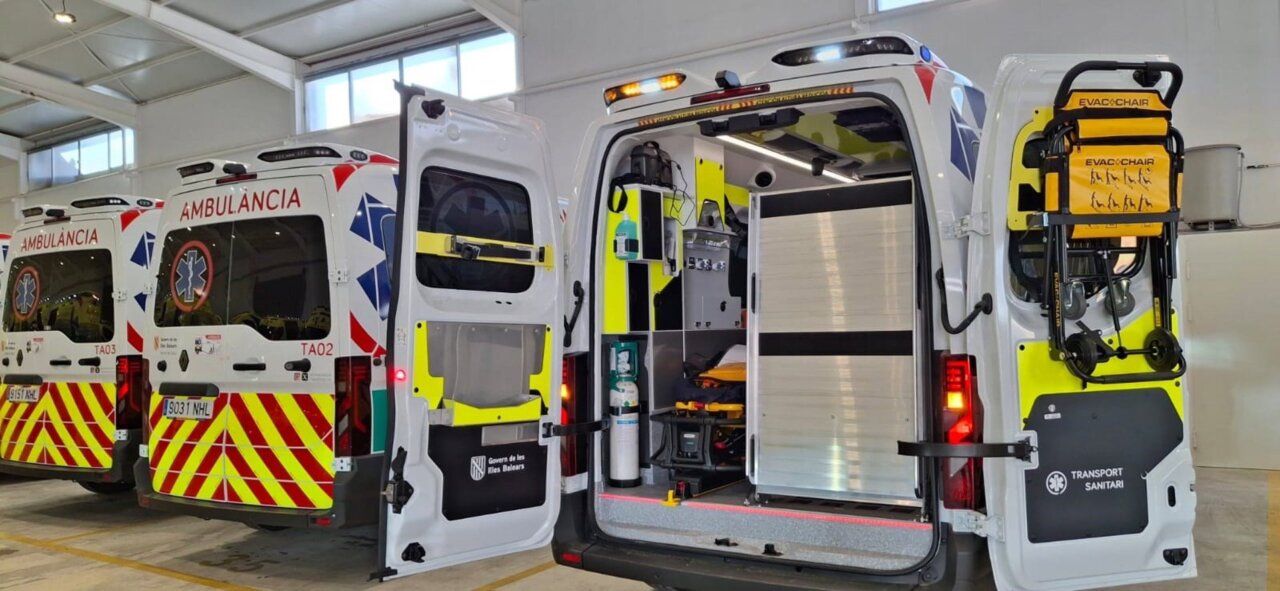
The IbSalut begin to deploy, starting this Wednesday, the fleet of ambulances and urgent transport programmed in all the islands, gradually, as planned, after the controversy sparked by the weight of the units and the lack of drivers.
According to a statement issued by the Regional Ministry of Health, this is a strategic investment of 55.9 million euros invested in the acquisition of 246 vehicles under a five-year leasing contract, which includes maintenance and the corresponding insurance.
However, its start-up was delayed due to an unforgivable error in the bidding documents. Of the 246 vehicles tendered, 122 were practically unusable because the personnel did not have the corresponding driving license.
Most new vehicles can not be used normally because they exceed 4,000 kilos of weight, forcing drivers to have a driving license type C1, which only has a small percentage of staff. This affects the white ambulances, intended for
As a matter of urgency, the Regional Ministry of Health has had to partially dismantle some units to reduce their weight in order to be able to put them into operation. The Regional Minister Manuela García defended that the vehicles “will not entail any extra cost”, despite growing criticism from workers and the opposition.
Beyond this controversy, the new fleet of urgent and scheduled transport vehicles has been designed by professionals, following technical criteria, in order to respond to the current needs of patients, because in recent years the user profile has changed, according to the department headed by Manuela García.
The new ambulances incorporate improvements for both users and professionals. New types of vehicles have also been incorporated to meet the new operational and assistance needs of the service.
In the case of emergency medical transport, the new ambulances incorporate the“most innovative technological equipment”.
They are equipped with automatic changeover and stretcher beds with hydro-pneumatic suspension for improved comfort while driving and safety for critical patients. They also incorporate improvements in air conditioning and in the air filtration and disinfection system in the cabins.
Scheduled transportation
Meanwhile, scheduled transport ambulances will be the first complete fleet in Spain to carry electric stretchers in all vehicles (until now they were all manual), which will allow professionals to reduce the effort when handling loads and improve patient safety.
In addition, the number of ambulances with hydraulic platforms has been increased to better adapt to the profile of outpatients in wheelchairs.
Other improvements include the installation of a video camera surveillance system to monitor patients and the redesign of the passenger compartment to make it more accessible and comfortable en route. As in the case of emergency transport, all ambulances have an air filtration and disinfection system in the cabins.
Deployment of the new fleet
The deployment of the new fleet will begin progressively and simultaneously on the four islands. In total, there are 116 emergency medical transport vehicles and 130 scheduled medical transport vehicles.
Specifically, 169 vehicles will be deployed in Mallorca (76 for urgent transport and 93 for non-urgent transport); in Menorca, 35 vehicles (18 for urgent transport and 17 for non-urgent transport); in Ibiza, 38 vehicles (19 for urgent transport and 19 for non-urgent transport) and in Formentera, 4 vehicles (3 for urgent transport and 1 for non-urgent transport).
The new ambulance contract provides for the incorporation of 12 more scheduled medical transport vehicles and 15 more emergency medical transport vehicles.
Among others, three vehicles to be used as mobile pharmacies, a pediatric ambulance with more space, three special vehicles to carry extracorporeal membrane oxygenation (ECMO) equipment, two pickups to access difficult areas and logistical support vehicles for ordinary emergencies and incidents with multiple victims.
It should be noted that the SAMU 061 service not only attends to daily emergencies; it is also in charge of high complexity transports throughout the archipelago, pediatric transport, air transport, transfers between hospitals and the management of all complex medical devices in the archipelago.
In total, it has 35 assistance bases spread throughout the country and 5 heli-spots. The optimal maintenance of all this network requires the use of suitable vehicles, which allow the work to be carried out with guarantees of safety and success. For this reason, there is an increase in the logistic support, pharmacy and mobility fleet.
Continue reading:
-
Health alert: unlicensed drivers for new ambulances in Ibiza and Formentera
-
UGT denounces deficiencies and discrimination in the ambulance service of Ibiza and Formentera
-
IbSalut is condemned for a poorly treated sprain that resulted in serious sequelae
-
The price of premises in Ibiza complicates the expansion of an essential service