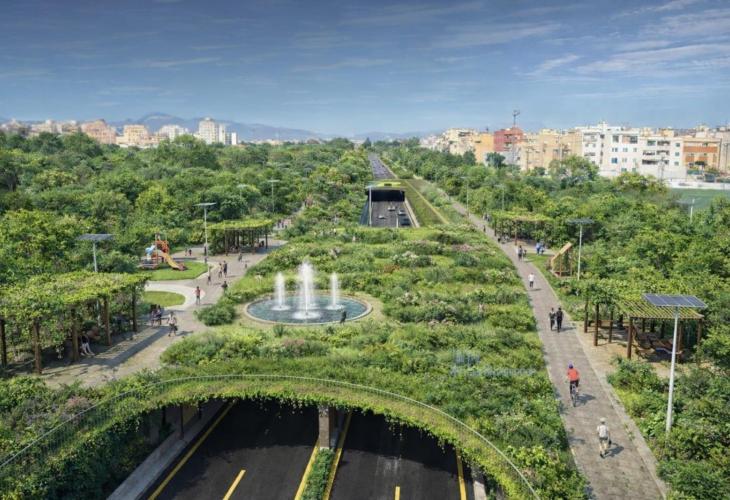
The PSIB-PSOE has registered a motion in the Consell de Mallorca and the City Council of Palma to promote a feasibility study of the undergrounding of the Via de Cintura (Ma-20), the main ring road of the city. The initiative proposes to eliminate the urban barrier posed by this infrastructure and take advantage of the space freed to create a large green ring that connects historically separated neighborhoods, improves urban cohesion and facilitates new social and environmental uses.
The motion is presented in a context in which the PSIB-PSOE governed the City Council of Palma for eight years without promoting or formally considering the undergrounding of the Via de Cintura. The initiative is now registered from the opposition both in the Consell de Mallorca and in the Palma City Council.
The debate about the undergrounding of the Ma-20 is not new. In February 2022, the then manager of Urban Planning of Cort, Joan Riera, explained that the General Plan of Palma contemplates this action to eliminate the urban fracture caused by the infrastructure in neighborhoods such as Son Gotleu, Son Güells or Rafal. According to him, the objective would be to reduce noise in the nearest houses, improve road safety and prevent certain streets from continuing to function as bottoms of sacks.
The motion proposes a preliminary study to analyze the elimination of the road barrier that, according to the PSIB, separates neighborhoods such as Son Gotleu, Nou Llevant, la Soledat, Son Malferit or Rafal Vell from the rest of the city. The freed space would allow the creation of green areas, public facilities and new pedestrian and cycling routes, in addition to improving urban cohesion in areas with historical deficits of services.
The proposal was presented on one of the bridges of the Via de Cintura, with the presence of neighborhood representatives and socialist officials of the Consell and the City Council of Palma. It was attended by the deputy spokeswoman of the Socialist Group in the Consell, Sofia Alonso; the councilor-elect Joan Ferrer; and the aldermen Xisco Dalmau and Daniel Oliveira, along with representatives of neighborhood associations. The project is planned in phases, starting with the sections that affect the most vulnerable neighborhoods, and would require the collaboration of the City Council, the Balearic Government and the central government, as well as the search for European funding.
Continue reading:
-
In Ibiza, Unidas Podemos explores expanding its coalition to the left of a PSOE in decline
-
PSOE and Unidas Podemos demand the Consell de Ibiza to maintain the free transport to registered residents without DNI (identity card)
-
The Government dismantles the PSOE’s denunciation on the pre-emption and withdrawal in the purchase of houses.