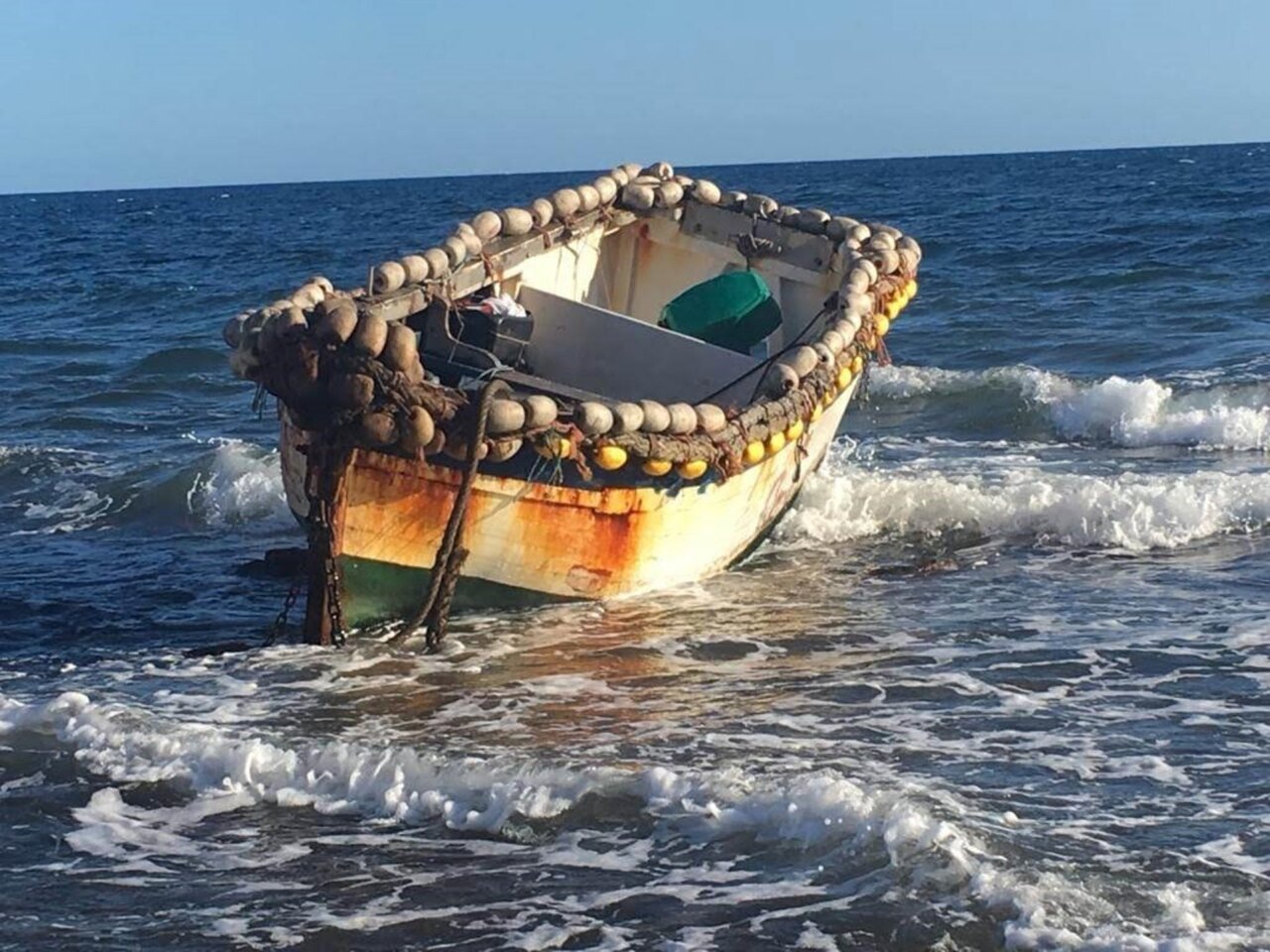
Migration to the Balearic Islands is changing its face. Although the route to Ibiza and Formentera has been associated for years with departures from Algeria with a majority Algerian population, in 2025 a phenomenon is consolidating that can no longer be considered marginal: the increasing appearance of people from the Horn of Africa, especially Somalia, in a corridor that combines forced displacement, long itineraries and extreme risk in the maritime section.
The Spanish Commission for Refugee Aid (CEAR) has detected a 27% increase in the transit of migrants through the route between Somalia and the Balearic Islands, identified at the end of last year. The NGO attributes this to a mechanism that is repeated in the Mediterranean: when one route is closed, others are opened, often longer and therefore more dangerous. A phenomenon also described in the recent annual report Monitoring the right to life, by the NGO Caminando Fronteras.
The “displacement effect
CEAR’s data comes in a context in which, according to its annual balance on migration and asylum, maritime arrivals to Spanish coasts have decreased, largely due to border control and externalization agreements with third countries such as Morocco, Mauritania and Senegal. This decrease, the organization points out, has been particularly noticeable in the Canary Islands, with 60% fewer arrivals compared to the previous year.
But the movement does not disappear: it is reconfigured. And the Balearic Islands appears as one of the destinations where routes are rearranged when other gateways harden.
Not only migration: refugee and war trajectories
The growth of transit from Somalia is not only a quantitative change. It also implies a qualitative change: these are profiles linked to contexts of conflict and humanitarian crisis, with a higher burden of forced displacement.
CEAR warns that global displacement crises persist and cites the worsening of scenarios such as Sudan, the Sahel or Gaza, in addition to other hotspots of conflict. In the Sudanese case, it recalls that the humanitarian crisis is worsening far from the media spotlight and that more than 13 million Sudanese people remained forcibly displaced by mid-2025, according to UNHCR.
The surge of Somalis on the route to the Balearic Islands fits this picture: it is not just a migration for opportunity, but a sustained flight from collapsing contexts, where international protection should be a focal point.
This background appears starkly in testimonies collected by human rights organizations. In the Caminando Fronteras report, a Somali asylum seeker summarizes the logic of these trajectories: previous violence, extortion, imprisonment and, finally, the sea. “We arrived in Libya and it was hell… They locked us up… they wanted money… some people died there… We took a boat… the weather was terrible and I thought I was going to die… Alhamdoulillah we arrived in Spain… but I have a hard time sleeping…”.
The testimony introduces a key element to understand what is happening in the Balearic Islands: those who arrive by this route not only arrive physically exhausted; they arrive with deep psychological consequences and, in many cases, with clear reasons to ask for protection.
In 2025, the organization documented 1,037 victims linked to the Algerian route to the Balearic Islands, grouped in 121 maritime tragedies, and highlights a key fact to understand the level of risk: 47 boats disappeared with all the people on board, without a complete public reconstruction of what happened or a clear traceability for the families.
In this context, the influx of Somalis takes on a different meaning: they do not arrive only from an exit point, but from a trajectory marked by previous violence and flight.
From the Horn of Africa
The route that leads to the Balearic Islands no longer responds to a “classic” and homogeneous pattern. Although Algerian nationality is still the majority, the organization warns of a sharp increase in the number of people from the Horn of Africa, especially Somalia, and also from Sudan and South Sudan, to the point of identifying boats composed entirely of Somalis. This change makes Algeria not only a point of departure, but increasingly a transit country for migrants from East Africa – and also, on occasion, from the Sahel – who end up trying to cross the Balearic corridor.
This transformation has a human dimension that the report portrays with crudeness in the testimony of M.B., from Mali, who is looking for his younger brother, who disappeared after leaving Algeria. “He is 16 years old, he is my brother…that day I was supposed to cross with him but I couldn’t because there was a raid…they deported me to the desert…he rode in the boat…since then I am still searching…the boat is missing,” he recounts. The case illustrates a key element of the nationality shift: many of these people arrive in Algeria having been expelled, persecuted or displaced by previous stages of the journey, and make decisions under pressure that increase exposure to risk and disappearance without trace.
Caminando Fronteras also stresses that the route to the Balearic Islands incorporates profiles that were previously residual in this corridor: in addition to the Algerian presence, it also detects Syrians and Palestinians, and warns that the Balearic stretch is receiving more and more people from different parts of the African continent. This diversification is also reflected in the minors: the report identifies an increase in migrant children in the western Mediterranean and mentions Algeria, Mali, Guinea and Somalia as the main origins, a combination that reinforces the idea that the Balearic Islands is no longer just a destination for one nationality, but the end of longer, more mixed migratory trajectories, often linked to forced displacement.
The impact on the Balearic Islands: a welcome challenge that is not the same
The emergence of Somalis -and of other origins outside the historical pattern of this route- poses a different challenge for the reception and care system: more complex health needs, language barriers, assessment of international protection and psychosocial accompaniment. Managing a relatively homogeneous flow is not the same as managing a corridor where refugee profiles with experiences of war, persecution or extreme violence burst in.
CEAR, moreover, places this context in a year marked by a harsher political climate. The organization regrets that 2025 was the year in which anti-immigration policies “boosted hate speech,” warning of their impact on coexistence and citing episodes of finger-pointing and hate crimes fueled by misinformation.
Asylum: fewer applications, more rejections
Another point CEAR highlights is the evolution of the asylum system. According to the NGO, the recognition rate in Spain continues to be low: only 11% of the applications resolved up to November 30 obtained a favorable response, worsening with respect to the previous year. And the unfavorable resolutions have grown again to 44%.
In addition, CEAR points to an overall decline in the number of applications: with one month left in the year, they stood at 134,401, down 14% from the same period in 2024.
This scenario is especially relevant for profiles such as those emerging on the Somalia-Balearic Islands route: people arriving with a potential need for protection, but in a system that hardens access, delays processes or frequently returns negative responses.
A route that can no longer be explained by one nationality alone
The 27% increase detected by CEAR and the testimonies of Somali people point to one conclusion: the Balearic Islands is no longer just the border of a nationality, but the final destination of much more complex migratory trajectories, where the component of refuge and forced displacement gains weight.
And that forces us to rethink the public debate: not only from security or control, but from protection, asylum and the human impact of routes that change precisely because others are closed.