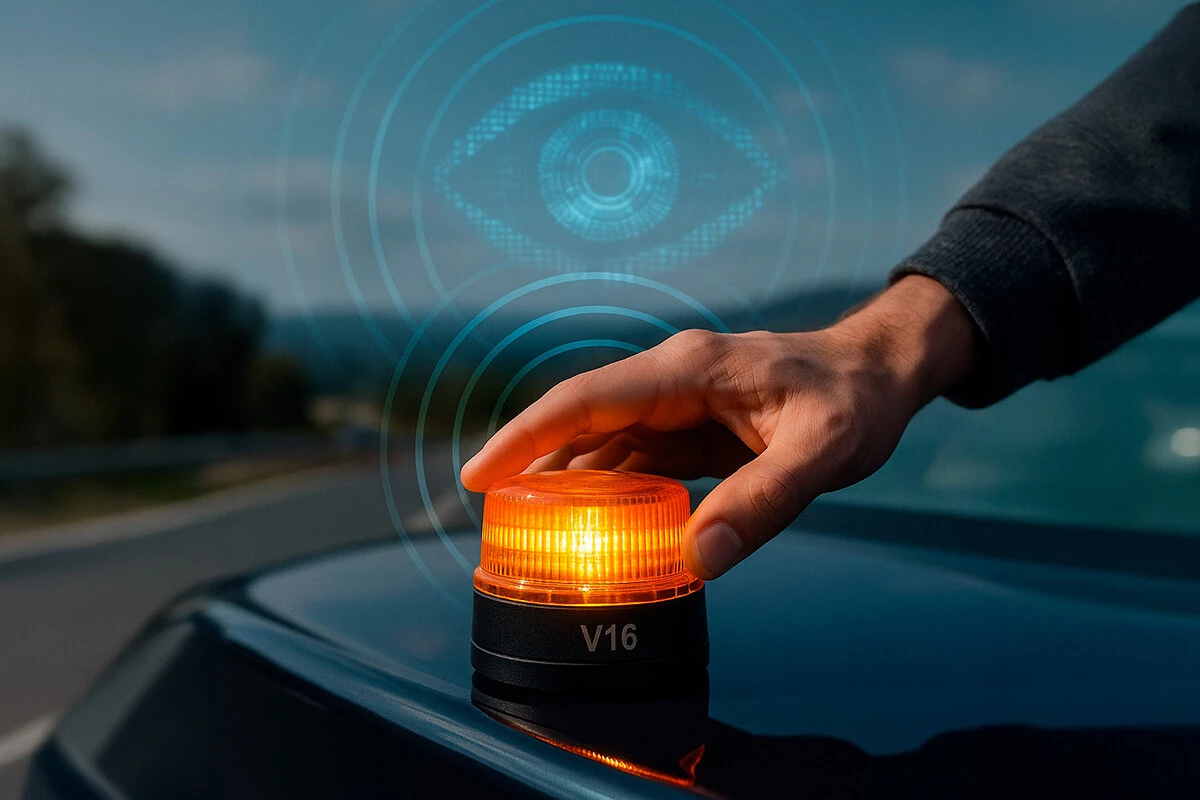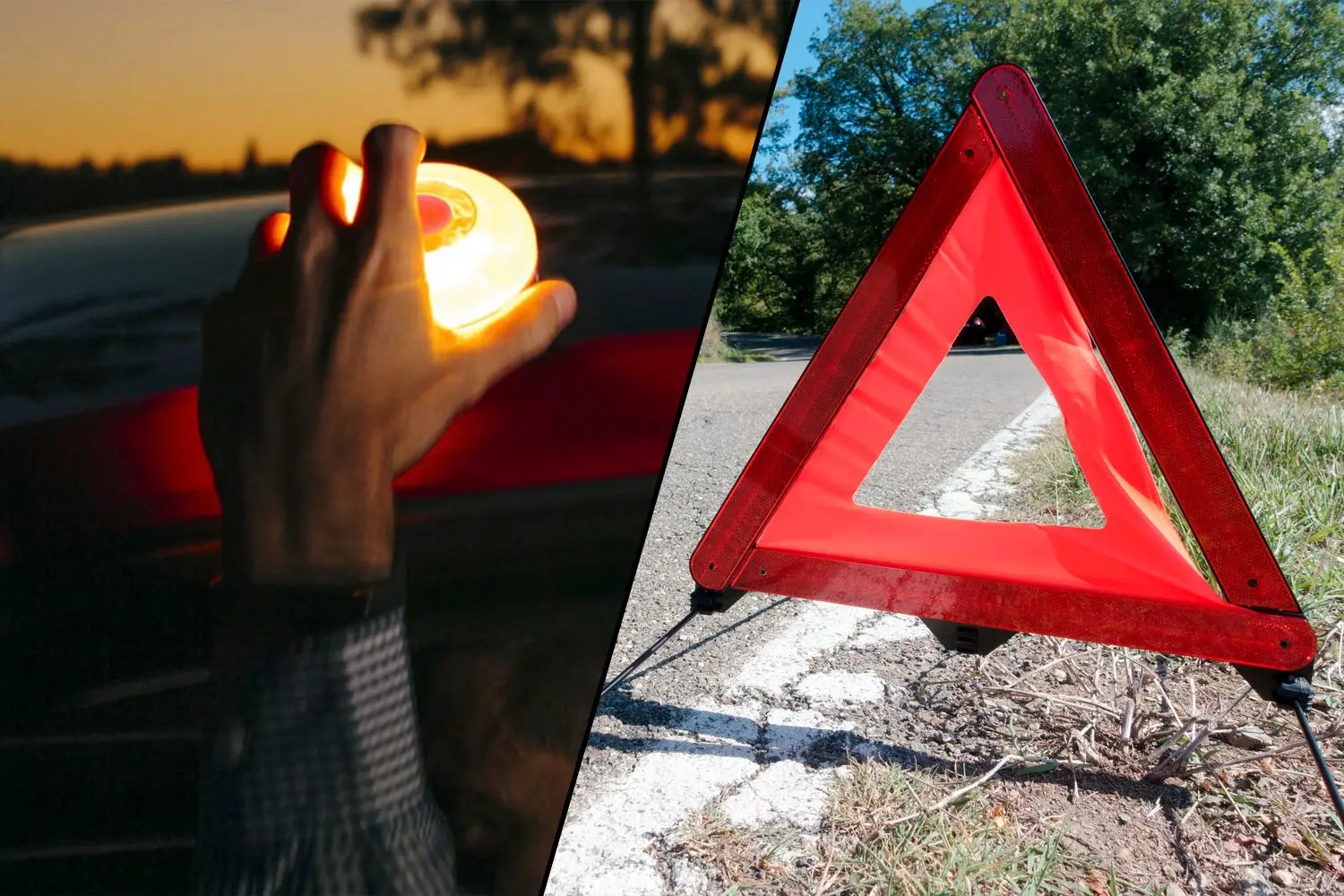
January 1st will mark a turning point in road safety in Spain. As of that date, the traditional emergency triangles will definitively cease to be the pre-signaling system for danger on the road and will be replaced by the V-16 beacon, a connected luminous device that is already familiar to most drivers. However, together with this mandatory transition, the Dirección General de Tráfico (DGT) is preparing another less visible but equally relevant change: the arrival of the V-27 beacon, known as the ‘virtual triangle’.
Although its name is beginning to be heard, the V-27 will not replace the V-16, nor will it be mandatory. Its function will be complementary and will rely on vehicle connectivity to warn drivers of accidents, breakdowns or obstacles on the road even in situations where the light of the physical beacon is not perceptible.
A new scenario after the removal of the triangles
From January, emergency triangles will no longer be used on Spanish roads. In their place, the regulation establishes the V-16 beacon as the only device for pre-signaling danger in the event of an incident or breakdown. This element will be mandatory for passenger cars, vans, buses, trucks, mixed vehicles and non-special vehicle combinations.
In the case of motorcycles, its use will not be mandatory, but it is recommended for safety reasons, since it prevents the driver from having to get off the motorcycle and walk on the road to signal an incident.
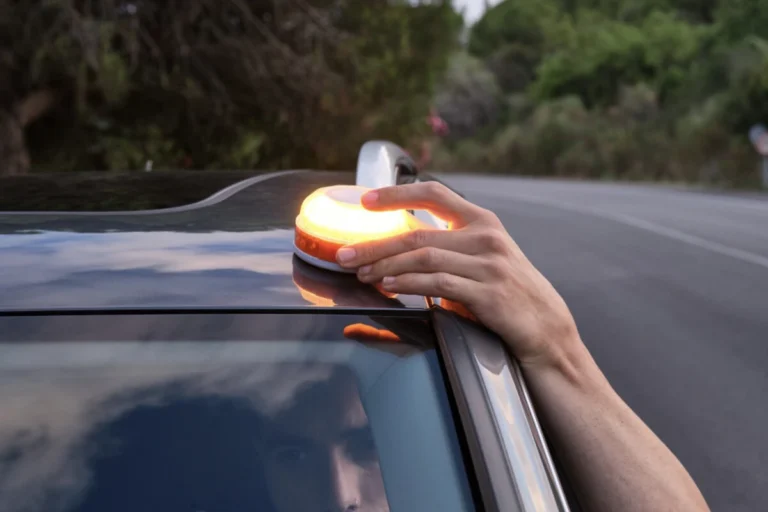
The V-16 is designed to be placed on the roof of the vehicle, emits a visible light signal and, in addition, has geolocation, which allows the exact location of the incident to be sent to the DGT traffic systems.
What exactly is the V-27 beacon
In this new ecosystem comes into play the V-27 beacon, defined by the DGT itself as a ‘virtual triangle’. Unlike the V-16, it is not a physical object and does not require the driver to place it manually at any point of the vehicle.
The V-27 manifests itself as a digital signal that appears directly on the car’s instrumentation, alerting the driver of a road hazard well in advance. Its purpose is to warn of a nearby incident even before the vehicle reaches the affected area.
This system will be especially useful in circumstances where the V-16 beacon may lose visual effectiveness, such as during daytime, curves, changes in gradient or areas with reduced visibility.
A complement, not a substitute
Traffic authorities insist that the V-27 does not replace the V-16 beacon in any case. The V-16 will continue to be the mandatory physical device for signaling a breakdown or accident, while the V-27 will act as an additional layer of information for other road users.
The DGT argues that this combination reduces the risk on the road compared to the old system of triangles, which forced drivers to get out of the vehicle and expose themselves to traffic.
In this sense, Indalecio Candel, representative of the DGT, recently explained that the new connected technology “will allow us to receive a signal (…) and we can warn the rest of the users about the location of the incident”.
How the V-27 signal will reach the driver
The V-27 beacon will work thanks to the connectivity of the vehicle with traffic systems, receiving information on incidents detected through the V-16 beacons activated by other drivers.
When a vehicle with V-27 approaches an area where there is a marked breakdown or accident, the system will display a visual alert on the instrument panel, allowing the driver to exercise extreme caution in advance.
As it is not physically supported, the V-27 is directly dependent on the vehicle being equipped with compatible and connected systems, which is becoming increasingly common in newer models.
Compulsory V-16, voluntary V-27
One of the key points is that, while V-16 will be mandatory, V-27 will be optional. It will not be required by law and its availability will depend on the technological equipment of the vehicle.
This means that not all drivers will receive these digital alerts right out of the box, but those whose cars have instrumentation systems capable of displaying the virtual signal will.
The DGT considers that this progressive implementation model will allow the system to be adapted to the vehicle fleet without imposing new immediate obligations.
Why the DGT bets on the ‘virtual triangle’.
The introduction of V-27 responds to a preventive safety logic. Although the V-16 significantly improves the situation with respect to triangles, its light signal may not be visible in certain circumstances.
The V-27 provides a warning before reaching the point of the incident, which is essential to reduce sudden braking, rear-end collisions or late reactions by drivers.
It also reinforces the concept of the connected road, where vehicles not only circulate, but also exchange relevant information in real time.
One more step towards connected mobility
The arrival of the ‘virtual triangle’ is a step forward in the digitalization of road safety. The DGT understands the V-27 as a logical complement in a context in which cars are increasingly connected and driving assistance systems are gaining prominence.
Although its implementation will be progressive and voluntary, its role may prove to be key in reducing secondary accidents and risk situations on the road.
With the entry into force of the V-16 and the future integration of the V-27, the emergency signaling system in Spain takes a technological leap that seeks to protect the driver without forcing him to expose himself to traffic, setting a new standard in the management of road incidents.