The doctors’ strike called by the Spanish Confederation of Medical Unions (CESM) and the Andalusian Medical Union (SMA) began this Tuesday, in a protest that will last until Friday and mobilizes more than 100,000 physicians throughout Spain. The strike is a response to the rejection of the new Framework Statute of the National Health System (SNS) proposed by the Ministry of Health, a reform that has unleashed strong unease among professionals.
The mobilizations have the partial backing of other unions and healthcare collectives, although there is not total unity within the sector.
Demonstration in Madrid: tiredness and frustration in the streets
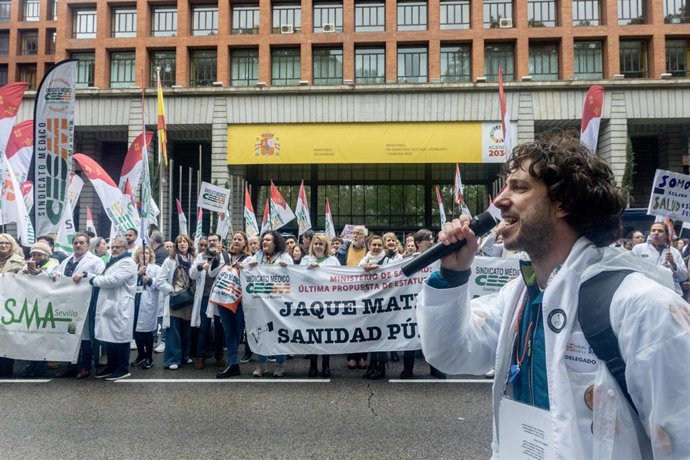
In Madrid, more than a thousand healthcare professionals took to the streets. The march started from the Congress and advanced towards the Ministry of Health with slogans such as “Monica, listen, it is also your fight”, chanted to the rhythm of a batucada.
Carrying white coats and placards, the demonstrators demanded better working conditions and specific recognition of their special responsibilities. One of the placards read: “for a separate statute for the medical and medical profession”, in reference to a central demand of the demonstrators.
Ana Giménez, president of Amyts, criticized the healthcare proposal: “I have worked five years on duty alone, which does not count towards my retirement,” she explained, according to El País. For her, joint negotiation with other healthcare categories makes no sense, since doctors and nurses do not share the same “responsibility” or work obligations.
The messages visible at the protest expressed a unanimous demand: “Guards, slave labor, they pay taxes but do not pay contributions”, “Doctor or slave? I don’t want to continue to be mistreated” or “Dignity and respect for our profession”.
Catalonia: pressure on the Conselleria and division over monitoring
In Catalonia, the union Metges de Catalunya, with 13,000 members, has supported the strike and led the protests. The staff of the public and subsidized system warned the Minister of Health, Olga Pané, that the mobilizations will continue until an exclusive negotiation space is achieved: the regulation of “care, organizational and labor aspects that specifically affect the medical profession”.
In a previous communiqué, the union stated: “maintaining a health care service sustained by the overexertion and exploitation of professionals has no further course”. The first follow-up data reflect the usual disparity: 6.5% according to the Generalitat, 45% according to the union.
Andalusia: patients’ disconcertment and fear that the protest will be confused with the healthcare crisis
In Seville, the strike surprised many families who went to the doctor’s office. “They told us that there was a strike and we don’t know whether to take him to the hospital for emergencies because there will also be doctors there who will have stopped,” lamented María Ángeles. Other patients expressed resignation at the accumulated delays in appointments: “A week’s wait… now we have to wait again,” said Orlando García.
At the San Juan de Dios Hospital in Bormujos, four people waiting to undergo cataract surgery had their operations suspended: “They told us all that our appointment was suspended, but they have not given us a new date,” explained one patient who claims to have been waiting a year for the specialist and four months for the operation.
Sources at the Regional Ministry of Health acknowledge their concern that citizens identify the strike with the Andalusian healthcare crisis: “They don’t understand what the framework statute is and that it depends on the central government, and that has repercussions for us”.
In Cadiz, staff at Puerta del Mar warned users about the reform: “It opens the door to creating in the future a health profession that allows non-physicians to diagnose and treat…a nurse can reach our same level,” warned an anonymous professional, concerned about a “downward leveling.”
What physicians are asking for and what the Health Service is responding to
The claims of the practitioners include:
-
A framework statute of its own.
-
Reduction of maximum weekly hours.
-
Better regulation of on-call duty, on a voluntary basis and with adequate remuneration.
-
Improvements in the professional category to differentiate medicine from other health professions.
-
Maintain compatibility between public and private work for service chiefs.
The Ministry of Mónica García rejects this normative separation outright. ” The possibility of a separate statute is not seen by anyone,” she stated in an interview with El País. For the minister, “the framework statute of the entire National Health System cannot be fragmented. We need cohesion, teamwork, rights and duties that are common”.
The new framework modernizes the 2003 regulations, limits the working week to 45 hours, regulates breaks and on-call time, incorporates digital disconnection and improves professional classification according to the Spanish Qualifications Framework (MECU).
But the strike committee claims that this “homogenization” is a downward levelling and that the small print allows the actual dedication to be extended without compensation.
A conflict that is widening and dividing the sector
The protests are taking place in a context of significant union division. The Agrupación por un Estatuto Médico y Facultativo (APEMYF) has called for new mobilizations for January with similar objectives.
Meanwhile, organizations such as SATSE-FSES, CCOO, UGT and CSIF have called indefinite strikes every Tuesday from January 27, although they reject the idea of an exclusive statute for doctors and criticize the reform proposed by the Health Ministry because, according to them, it does not benefit all public health professionals.
The strike, which will last until Friday, is being carried out under minimum services similar to a public holiday, which guarantees attention to emergencies and serious cases. Even so, the impact on patients and centers confirms the growing tension between healthcare professionals and the Ministry.