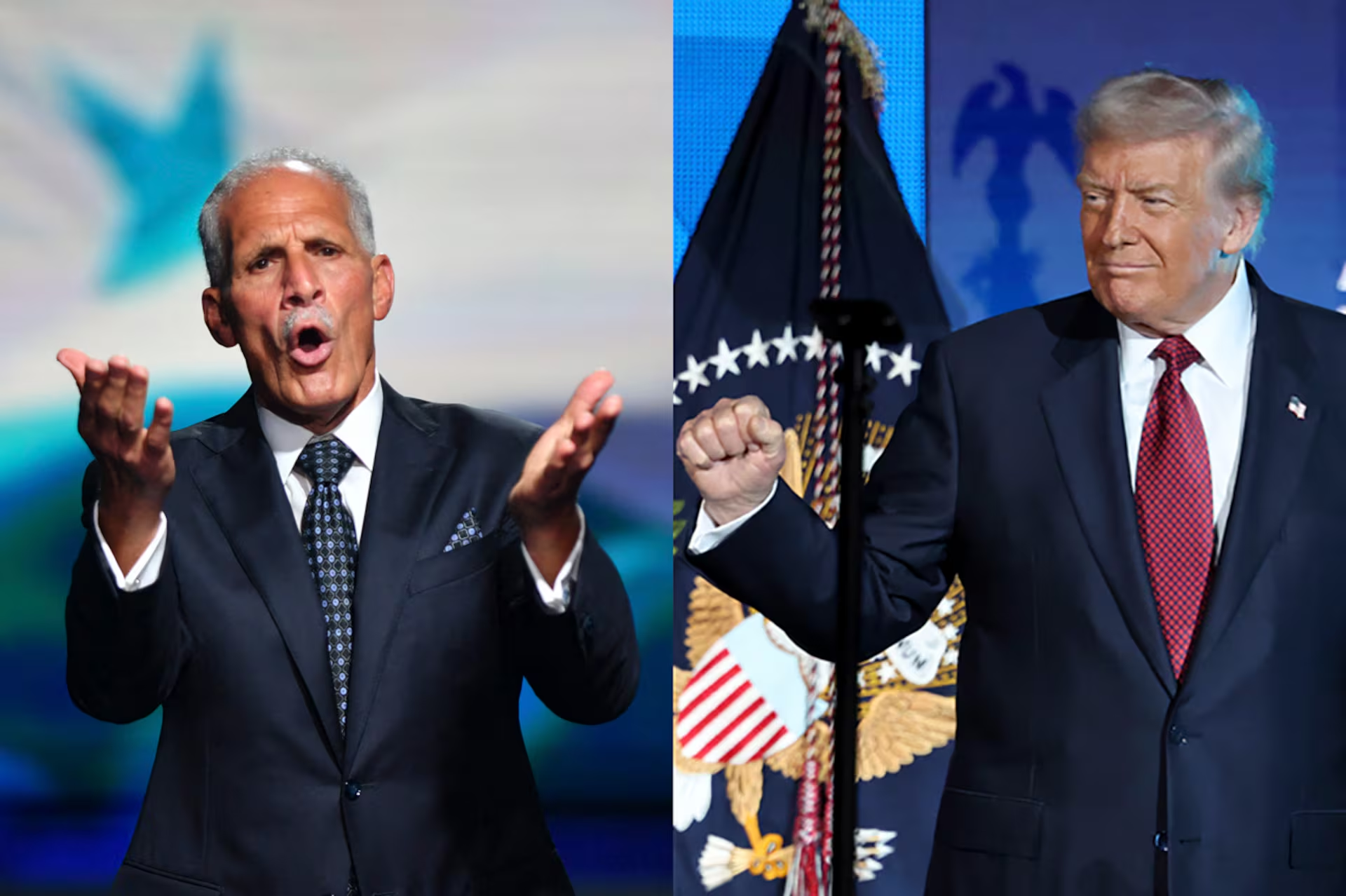
The preliminary count of the general elections held this Sunday in Honduras points to a political turn in the country. With 34.25% of the ballots counted, the conservative candidate Nasry Asfura, of the National Party, leads the results with 40.6% of the ballots, according to the electoral counselor Ana Paola Hall, who detailed that the recount includes 6,559 ballots out of a total of 19,152. The candidate, who was third in the polls and who received the explicit support of US President Donald Trump, thus becomes the surprise of the day.
He is closely followed by the liberal candidate Salvador Nasralla, with 38.8%, while Rixi Moncada, of the ruling Libre party, is at a distant 19.6%, a result that marks a considerable setback for the party founded by Manuel Zelaya.
Delays, mistrust and a country on edge
The day was marked by uncertainty. The National Electoral Council (CNE) did not release the preliminary data within the promised deadline (three hours after the polls closed, scheduled at 6:00 p.m. local time), which further strained an already tense atmosphere. The three main contenders were upset and demanded a clear answer.
Asfura asked for speed with a direct message: “Let us not keep the country on hold, on tenterhooks”. Nasralla, faithful to his religious tone, wrote in X:
The confusion worsened when the parties began to publish exit polls results proclaiming their respective candidates as winners. Nasralla even assured that he would triumph with “50% of the votes” and affirmed: “I am going to be president. Practically everyone here is voting for me”.
Trump, Milei and the shadow of the Hernandez case
Asfura’s advance in the polls reopens the debate about international influence in these elections. Trump not only expressed his support for the National Party candidate, but also promised to pardon former President Juan Orlando Hernández, sentenced in the United States to 45 years in prison for drug trafficking. Argentine President Javier Milei also endorsed Asfura.
It will be the CNE who will give the final result of the vote cast by more than 6.5 million Hondurans, in elections that faced continuity and change: the pro-government Moncada represented the legacy of Xiomara Castro, while Nasralla and Asfura headed the right-wing options.
A vote under a state of emergency and with a strong military presence
Honduras held these elections under a state of emergency, a measure of the Castro government to combat violence that has led to the deployment of the military as security guarantors. However, the president also assigned them functions that do not correspond to them legally: to watch over the transmission and custody of the minutes.
The Chief of the Joint Chiefs of Staff, General Roosevelt Hernández, was categorical: they will only recognize the new authorities when the CNE publishes the official results, completely ignoring the preliminary system(TREP), which is highly questioned by the ruling party.
High participation, technical failures and interference complaints
The polls opened at seven o’clock in the morning and from the beginning there was a massive influx. Jair Rico, custodian of the Libre party, explained that there were initial interruptions: “The system of the National Electoral Council was a little slow, because they were entering data from everywhere, but it was solved”.
Nicolás Carrasco, one of the voters interviewed, expressed his concern about corruption: “The people wanted the CICIH to be established, it was one of our priorities, because there is a lot of corruption, everything is well contaminated”.
Regarding the attitude of the candidates during the campaign, he was clear: “The candidates, instead of dedicating themselves to making proposals, they also insulted each other, they brought out all the bad, the ugly”. President Castro herself regretted the obstacles to this commitment: “Everything that was in my hands for the CICIH to come to our country, we took it here”.
International observers and a ‘civic party’ under surveillance
The process was monitored by the OAS, which deployed 101 observers in the 18 departments of the country, and by the EU-EOM, whose head, Francisco Assis, described the day as a “civic celebration”. However, the Network for the Defense of Democracy reported 4,427 incidents, from uninstalled ballot boxes to damaged material and problems in the biometric systems. They also recorded episodes in which the military demanded credentials from observers, an action outside their competence.
Luis Fuentes, Network observer in Tegucigalpa, denounced a military checkpoint that prevented the fluid entry of voters: “There had never been a military checkpoint to enter a school. The classrooms are empty, but the people are outside under the sun because the military have placed themselves there. This does not seem right to me, it is counterproductive”. He also added that the military presence generates intimidation: “The presence of the military generates these types of problems”.