
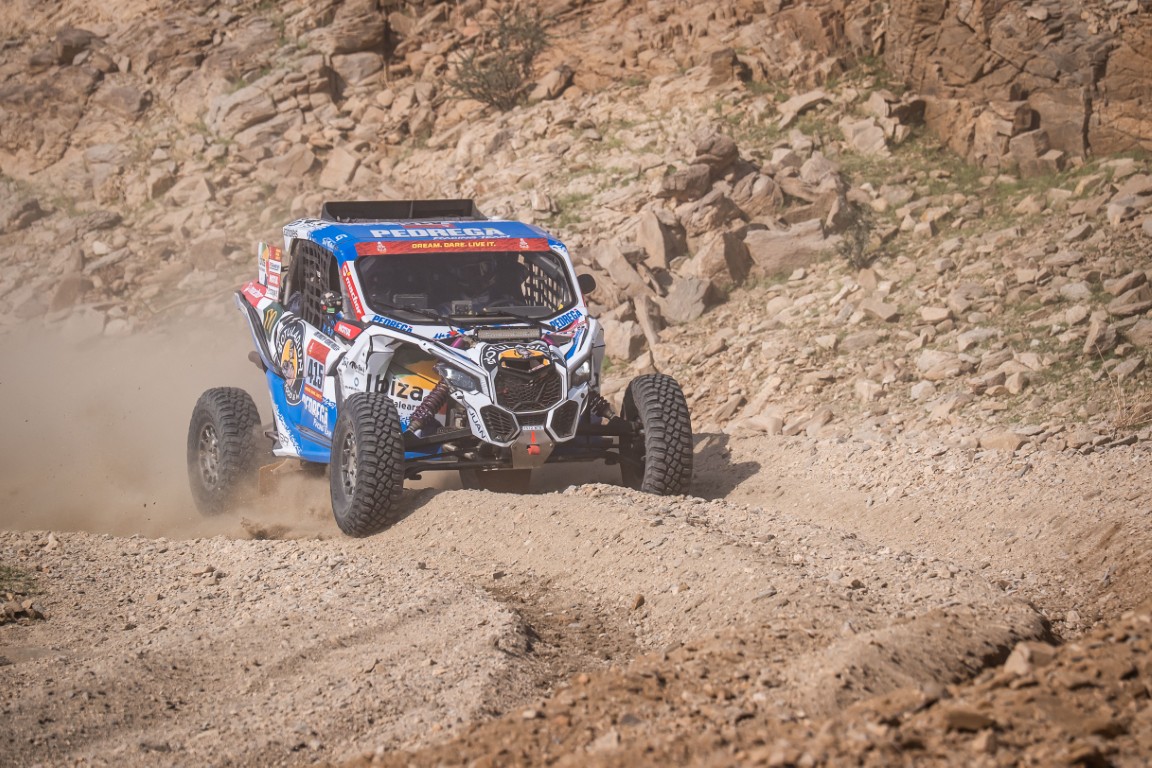
The Dakar 2026 is already underway and has done so without concessions. Stage 1, starting and finishing in Yanbu, was the first real test after the prologue and confirmed from the first day that this edition will not give any room for adaptation. In this context of maximum demand, Toni Vingut has overcome with solvency his debut as co-driver, completing the special stage with Gerard Farrés in the Side by Side (SSV) category.
The day was long and selective, designed to test both the endurance of the machines and the navigational skills of the crews. From the very first kilometers, the route combined fast tracks with broken and rocky sections, forcing them to manage their pace and make constant decisions to avoid mistakes that could jeopardize the rest of the rally.
The key role of the co-driver in side-by-sides
Side by Side (SSV) are light two-seater vehicles, with driver and co-driver seated side by side, a category of their own in the Dakar where navigation and coordination inside the cockpit are decisive. Unlike motorcycles or quads, here the co-driver is not a companion: he is responsible for reading the roadbook, orientation, control of limited speed zones and strategic management of the stage.
In a first day marked by the lack of visual references and constant changes of terrain, the work of Toni Vingut has been especially relevant. The navigation has been continuous and demanding, with several critical points indicated by the organization where any mistake could result in lost minutes or unnecessary wear of the vehicle.
Clean navigation and management despite setbacks
The stage was not without its difficulties. Farrés and Vingut suffered two punctures in the same wheel, a setback that caused them to lose time and put the team’s race management to the test. Far from taking risks, they opted to stay calm, resolve the incident and continue with a conservative strategy, prioritizing the completion of the special without serious mistakes.
One of the most positive aspects of the day was the fluidity of communication between driver and co-driver, a key factor in a discipline where understanding inside the vehicle makes the difference. This good coordination allowed them to maintain a solid pace and reach the final stages with a good feeling, especially in the sand.
Result and classification
Gerard Farrés and Toni Vingut have closed Stage 1 in 17th position, with a time of 04:00:29, 21:44 behind the winner, a result that also places them 17th in the general classification. A positive start in a Dakar that has already shown its toughest face and where consistency will be key to continue climbing positions.
Dakar gets down to business
With this first special stage completed, the Dakar 2026 is entering its decisive phase. The Saudi desert has begun to mark hierarchies and outline strategies, confirming that, especially in the Side by Side category, navigation, reliability and the role of the co-driver will be decisive in order to reach the finish with real options.
Next stage
Monday, January 5 – Stage 2: Yanbu > AlUla
-
Link: 104 km
-
Special: 400 km
-
Total: 504 km
The second stage will be the first long day of the rally, with a rapid change of scenery towards mountainous areas and rocky sections, where tire management and navigation will once again be the protagonists.